
Risk of ruin: the math of blowing up
There is a belief among traders that if you have an edge, you will be fine. Give it enough trades and the law of large numbers takes care of the rest.
That is true only if you are still trading when the large numbers arrive. Ruin is a path problem, not an average problem. The average outcome of a positive-edge strategy is a gain. The path to that average includes sequences that end the account first, and how often that happens is computable.
The classical formula
Take a simplified case: every trade risks the same amount, wins pay 1:1, and the outcomes are independent. Let p be your win probability and A be your edge, where A = 2p - 1. Let U be the number of bet-sized units in your capital, which for a fixed fraction f is 1 / f.
Probability of ruin = ((1 - A) / (1 + A)) ^ U
Take a solid edge: p = 0.55, so A = 0.10 and the base is 0.9 / 1.1 = 0.818.
- Risking 1%: U = 100, ruin probability about 0.0000002%
- Risking 2%: U = 50, about 0.004%
- Risking 5%: U = 20, about 1.8%
- Risking 10%: U = 10, about 13.4%
- Risking 20%: U = 5, about 36.7%
- Risking 25%: U = 4, about 44.8%
The edge is identical in all six rows. The strategy is identical. A trader risking 20% per trade with a genuinely profitable system loses everything roughly one time in three.
The row nobody wants to see
Now set p = 0.50 with 1:1 payoffs, so A = 0. The base becomes 1.0, and 1 raised to any power is 1.
Ruin probability: 100%.
With no edge, ruin is not likely, it is certain, given enough trades. Bet size only changes how long it takes. At p = 0.45 the base is 1.222, greater than one, and the formula caps at certainty even faster.
This is the sentence that matters: no amount of risk management saves a negative-expectancy system. Sizing controls the probability of surviving an edge. It cannot manufacture one. If your expectancy is below zero, the only intervention that changes the outcome is not trading that system.
Practical ruin comes far earlier than zero
Under fixed fractional sizing you never literally reach zero, because each loss is a percentage of what remains. That is comforting and irrelevant. An account down 80% is finished in every way that counts.
So define ruin as a threshold you would not come back from. Use 50%, which as the previous lesson showed requires a 100% gain to undo.
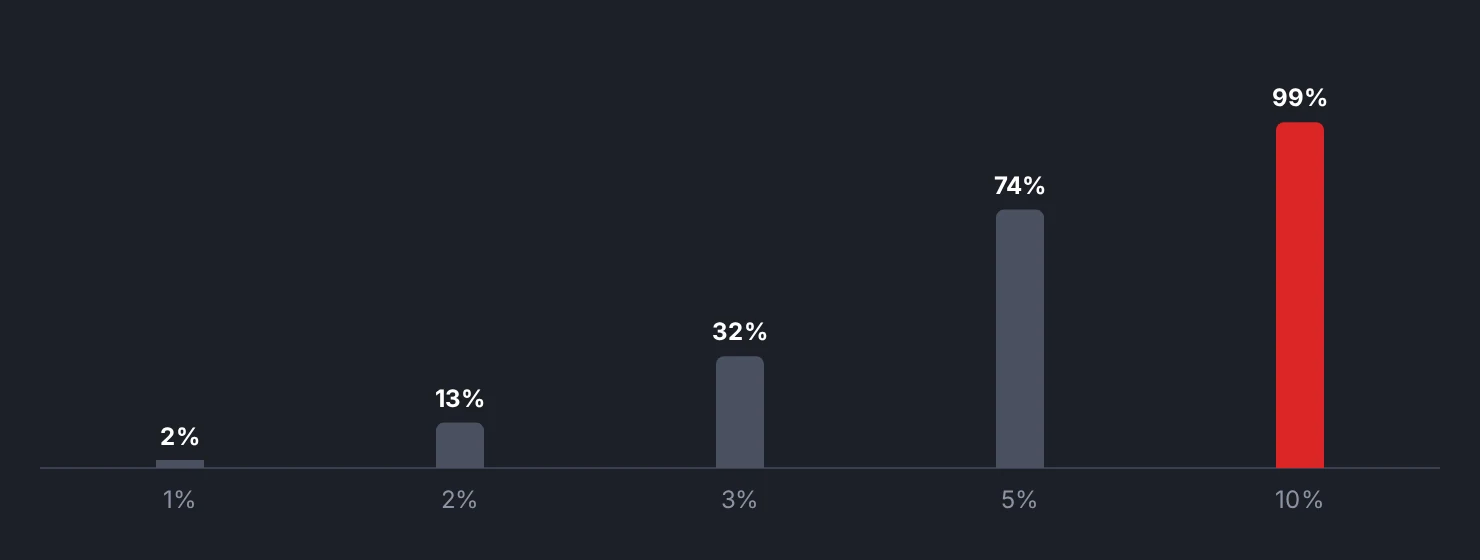
Using the same 55% edge and asking for the probability of ever being down 50%:
- Risking 1%: about 0.0001%
- Risking 2%: about 0.1%
- Risking 5%: about 6.6%
- Risking 10%: about 26.7%
- Risking 20%: about 54%
At 20% per trade, a profitable trader is more likely than not to halve the account at some point. At 0.75%, the number is not worth writing down. That is the entire argument for small risk per trade, stated as a probability rather than as caution.
Where Kelly fits, and why almost nobody trades it
The Kelly criterion gives the bet size that maximizes long-run growth rate. For p = 0.55 at 1:1, full Kelly is 10% per trade, which is the row with a 26.7% chance of halving the account.
Kelly is growth-optimal and psychologically unusable. Its drawdowns are savage by design, because the formula does not care how the ride feels, only where you end up after infinite trades. Practitioners who use it commonly trade a fraction of it. Half Kelly captures about three quarters of the growth rate with far shallower valleys, and quarter Kelly less still.
Retail risk settings of 0.5% to 1% are typically well under quarter Kelly for a realistic edge. That is not timidity, it is a deliberate trade of growth for the ability to keep executing, and it is where Indikora's 0.5% to 0.75% defaults sit.
What the formula quietly assumes, and why reality is worse
Three assumptions in the classical model all fail in the direction of more ruin, not less.
Independence. The formula assumes trades are unrelated. Ten crypto positions during a liquidation cascade are one trade wearing ten tickets, which is lesson 8.
A stable edge. p is treated as constant. Real edges decay, and regime changes can flip them for months without announcing it.
Clean fills. Every loss is assumed to be exactly one unit. Gaps, slippage and halts produce losses larger than 1R, and a distribution with a fat left tail raises ruin probability meaningfully above the formula's output.
So treat the numbers above as a floor. Whatever the model says your ruin probability is, the live version is higher.
The one control you have
You cannot set your win rate. You cannot make an edge persist. You can set the exponent, and the exponent is the only term in the equation that is entirely yours.
Having an edge does not make ruin unlikely, sizing does, and past a certain bet size a positive edge still ends in ruin more often than not.
Check yourself
Using your journal's measured win rate and reward-to-risk, compute your ruin probability at 1%, 5% and 10% risk per trade and note the size at which the number stops being negligible.
Position calculatorIndikora has a free simulator, bar replay and a behavioral coach that reads your own trades.
Open the app