
Position sizing: let the stop decide the size
Most traders size a position by feel. A number sounds right, or it is what they traded last time, or it is the amount that makes the potential profit look worth the effort. Then they place a stop wherever the chart looks sensible and find out what they actually risked only afterwards.
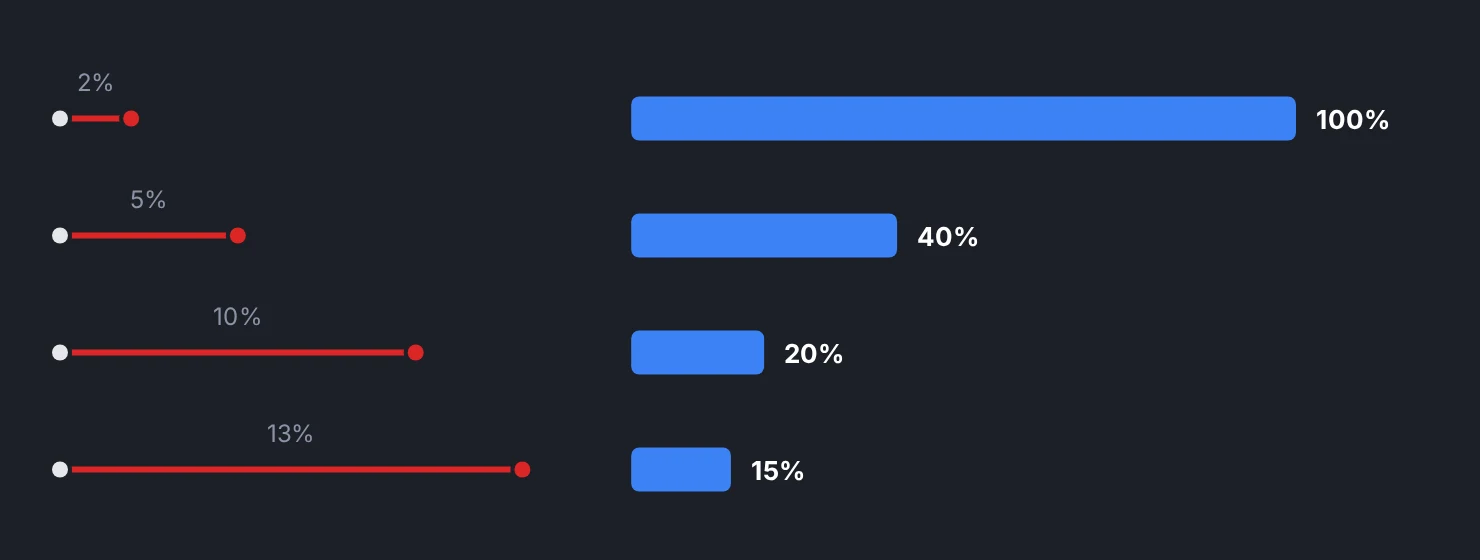
That is backwards, and it produces a book of trades where the risk swings between 0.2% and 5% for no reason anyone chose. Sizing is a division problem with two inputs: the dollars you are willing to lose, and the distance from entry to stop.
The formula
Position size = (equity x risk percent) / (entry price - stop price)
That is the whole thing. The numerator is a decision you made in advance. The denominator is a fact about the chart. Nothing else belongs in the calculation, and in particular your conviction about the trade does not.
Work it end to end
Account: 10,000 dollars. Risk per trade: 0.75%. That is 75 dollars.
You want to take an asset trading at 42.50, and the stop belongs at 40.10 because that is where the structure sits. Stop distance is 42.50 minus 40.10, or 2.40 per share.
Size = 75 / 2.40 = 31.25 shares. You round down, always down, so 31 shares.
Check the actual risk: 31 x 2.40 = 74.40 dollars, or 0.74% of equity. Correct.
Now look at the position value: 31 x 42.50 = 1,317.50 dollars. That is 13.2% of the account sitting in one instrument, even though the risk is under 1%. Position value and risk are different numbers and confusing them is why people think 0.75% risk means a tiny, pointless position.
Change the stop, watch the size move
Same account, same 75 dollars of risk, same entry at 42.50. But this time the sensible stop is at 36.50, because the asset is more volatile and a closer stop would sit inside normal daily noise.
Stop distance is 6.00. Size = 75 / 6.00 = 12.5, rounded down to 12 shares. Position value is 12 x 42.50 = 510 dollars.
The second position is less than half the size of the first, in the same asset at the same price, purely because the stop is wider. That is the mechanism working correctly. A wider stop does not mean more risk. It means a smaller position at the same risk.
It works identically in crypto and forex
The instrument changes the units, not the arithmetic.
Crypto: account 10,000 dollars, risk 0.75% or 75 dollars. Entry at 61,200, stop at 57,800. Distance is 3,400. Size = 75 / 3,400 = 0.02206 units. Position value is 0.02206 x 61,200 = 1,350 dollars.
Forex: risk 75 dollars on a pair where a standard lot moves 10 dollars per pip. Your stop is 30 pips away, so a standard lot would risk 300 dollars. Size = 75 / 300 = 0.25 lots. On a 60 pip stop it would be 0.125 lots.
Three different markets, three different-looking numbers, one identical calculation.
The parts people get wrong
Leverage does not change your risk, it changes what you can afford to hold. If your calculated position needs 1,350 dollars of exposure and you only have 800 dollars free, leverage lets you take it. It does not make the loss bigger or smaller. The loss is still 75 dollars if the stop fills at the stop. What leverage does change is your margin cushion, and a margin call can close the position before your stop ever gets a chance.
Costs come out of the same 75 dollars. Spread, commission and slippage are part of the loss, not extra. If the round trip costs 6 dollars, your real risk on that trade is 81 dollars, or 0.81%. On tight stops this matters a lot, which is the subject of lesson 9.
Gaps break the guarantee. The stop distance defines your intended loss, not your maximum loss. An asset that closes at 42.50 and opens at 37.00 fills you well below 40.10 and the 75 dollars becomes 170. This is not an argument against stops, it is an argument for the size being small enough that a bad fill is survivable.
Indikora derives every position size from the chandelier stop distance, which is 3 x ATR below the highest price since entry. A volatile asset gets a wider stop and, automatically, a smaller position for the same 0.5% to 0.75% of equity.
The habit worth building
Before every entry, say the three numbers out loud: risk in dollars, stop distance, resulting size. If you cannot state all three, you do not have a trade, you have an opinion with money attached.
Position size is a division problem: dollars you are willing to lose, divided by the distance from entry to stop.
Check yourself
Take the same entry price and run it through the position-size calculator three times with the stop 1%, 3% and 6% away, and record how the share count and the position value change while the dollar risk stays fixed.
Position calculatorIndikora has a free simulator, bar replay and a behavioral coach that reads your own trades.
Open the app