
The entry rule: SMA50 and 28-day momentum
Most people do not have an entry rule. They have an entry feeling, wrapped in enough indicators to make it feel researched. The evidence is that they cannot state, in advance, what would have to happen for them to buy tomorrow. If you cannot write it as a sentence someone else could execute, it is not a rule.
Indikora's entry rule is one sentence: on the daily close, if price is above SMA50 and price is higher than it was 28 days ago, and the asset was not already eligible yesterday, the asset enters. Everything else in this lesson is why it is shaped that way and what it costs.
Eligibility is a state, entry is an edge
The two conditions describe a state the asset is in. Being in that state is not a reason to buy, because an asset can sit in it for months. What triggers an entry is the transition into it.
The engine acts on the first close where both conditions become true together. If price crosses above SMA50 while momentum is already positive, that close is the entry. If momentum turns positive while price has been above SMA50 for weeks, that close is the entry instead. Order does not matter, the conjunction does.
This is why the same asset does not generate a new entry every day it remains in an uptrend. One transition, one entry. If the state breaks and later re-forms, that is a new transition and a new entry, and yes, that can happen twice in a month during a choppy stretch.
Why the close, and not the moment the condition is met
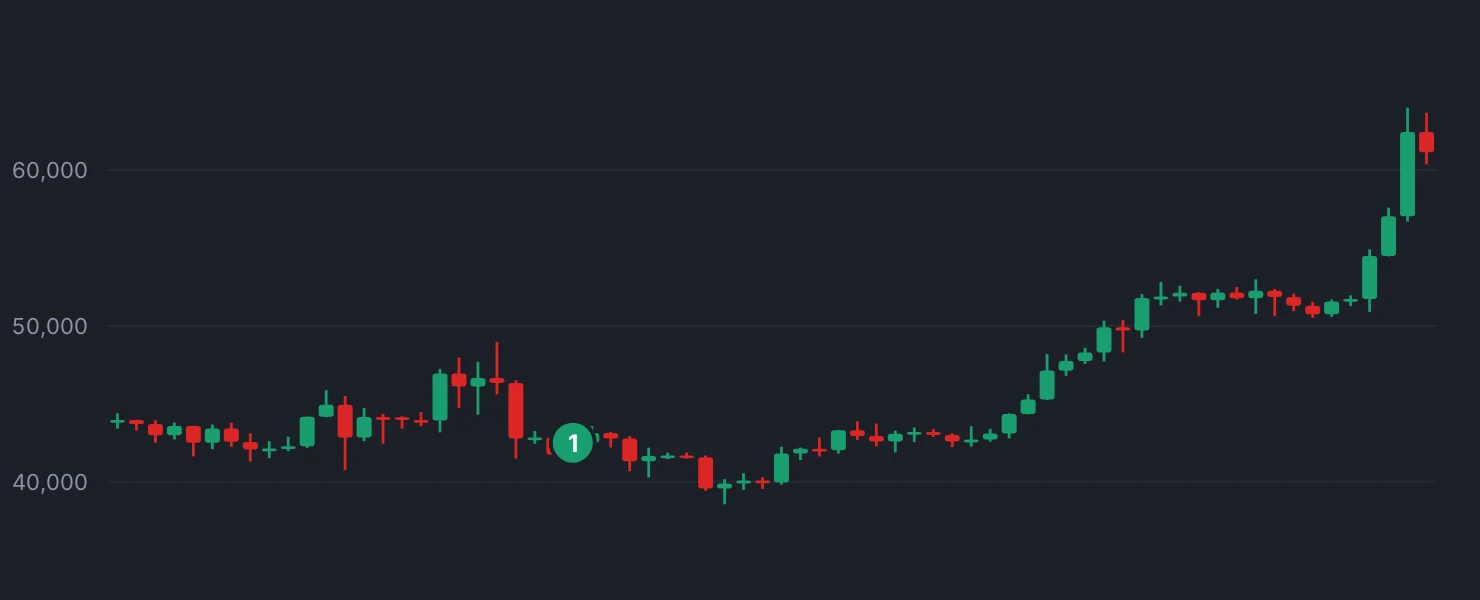
Intraday, price crosses above a moving average constantly and crosses back. A rule that fires the instant a condition is touched will fire many times a day on the same asset without anything having changed.
Waiting for the daily close is a filter against your own screen. The close is the only price of the day that a large number of participants had to agree on with the session ending. It is also the only one that is unambiguous after the fact, which matters for a track record that is meant to be checkable.
The cost is direct and measurable in every single trade: you enter later and worse than someone who bought the intraday cross. On days with a strong close, the difference is large. You are paying a worse average entry price in exchange for far fewer false entries, and there is no configuration where you get both.
There is a second cost that shows up in gaps. When an asset closes eligible and opens the next session substantially higher, the entry happens at a price nobody could have planned around. Mechanical rules do not protect you from gaps. They just make sure you are not improvising when one happens.
Where the position size comes from
The entry rule decides whether. It does not decide how much. Size comes from the exit, not the entry.
Once the entry price is known, the initial stop distance is known, because the exit rule places the stop at a fixed multiple of ATR below the running high. Risk per trade defaults to between 0.5% and 0.75% of equity depending on the selected style. Position size is whatever quantity makes the distance from entry to stop equal to that percentage of equity.
The practical consequence is that a volatile asset gets a smaller position, automatically. Not because volatility is judged bad, but because the stop has to be further away to survive normal noise, and the same percentage of equity buys less at a wider distance. Two entries on the same day can differ in size by a factor of several, and neither one represents more conviction than the other.
What this rule is bad at
It is late by construction. Both conditions require history. There is no version of a confirmed-close entry that gets you in near a low.
It clusters. When a whole market turns at once, many assets satisfy the conditions on the same close, and a portfolio can go from mostly flat to broadly exposed in a couple of sessions. That concentration is a real risk, and it is why a separate regime filter exists.
It has no opinion about value. The rule does not know whether an asset is expensive. It knows the asset is above its own recent average and higher than four weeks ago. Those are different questions, and this rule only answers one of them.
It repeats after failure. If a trend forms, breaks, and forms again, the rule takes the second entry with no memory of the first. That is either discipline or stubbornness depending on the month, and the engine cannot tell the difference in advance.
The value of a written entry rule is not that it is optimal. It is that when a trade goes wrong you can tell whether the rule failed or you did. That distinction is impossible to make with an entry feeling, and it is the only thing that makes improvement possible.
An entry fires only on a confirmed daily close where both conditions are true, which trades a worse average price for a countable rule.
Check yourself
Take one entry price and its stop distance, run it through the position-size calculator at 0.5% risk and again at 0.75%, and write down how much the resulting position quantity changes.
Position calculatorIndikora has a free simulator, bar replay and a behavioral coach that reads your own trades.
Open the app