
The exit rule: the chandelier stop at 3 x ATR
Entries get all the attention and decide almost nothing. Two traders can take the identical entry and end the year in completely different places, because one held through a 40% drawdown in the position and the other sold on the first red week. The exit is where the outcome actually lives, and it is the part most people leave undefined.
The tempting fix is a fixed stop: 5% below entry, or a round number that feels safe. It fails for a specific reason. A fixed percentage means nothing without knowing how much the asset normally moves. Five percent is a catastrophe for one instrument and a Tuesday for another. A stop that ignores that will be hit constantly on volatile assets and sit uselessly far away on calm ones.
What ATR measures, and why the stop is built on it
Average True Range is the average size of a bar's full range over a lookback window, including gaps from the previous close. It is a measure of normal movement. Not direction, not risk, just how far this asset typically travels in a day.
ATR turns "how much room does this need" into a number the engine can compute per asset. A stop set at 3 ATR is three times the asset's own normal daily range. On a quiet instrument that might be a few percent. On a volatile one it might be many times that. In both cases it means the same thing: far enough that ordinary noise will not reach it.
The multiple matters. At 3 ATR, the stop is deliberately loose. A tighter multiple, say 1.5, produces cleaner exits near tops and gets hit by routine pullbacks that resolve upward. A wider one, say 5, holds through almost everything and hands back an enormous amount when a trend finally ends. Three is a position on that spectrum, not a discovered constant, and reasonable systems sit elsewhere on it.
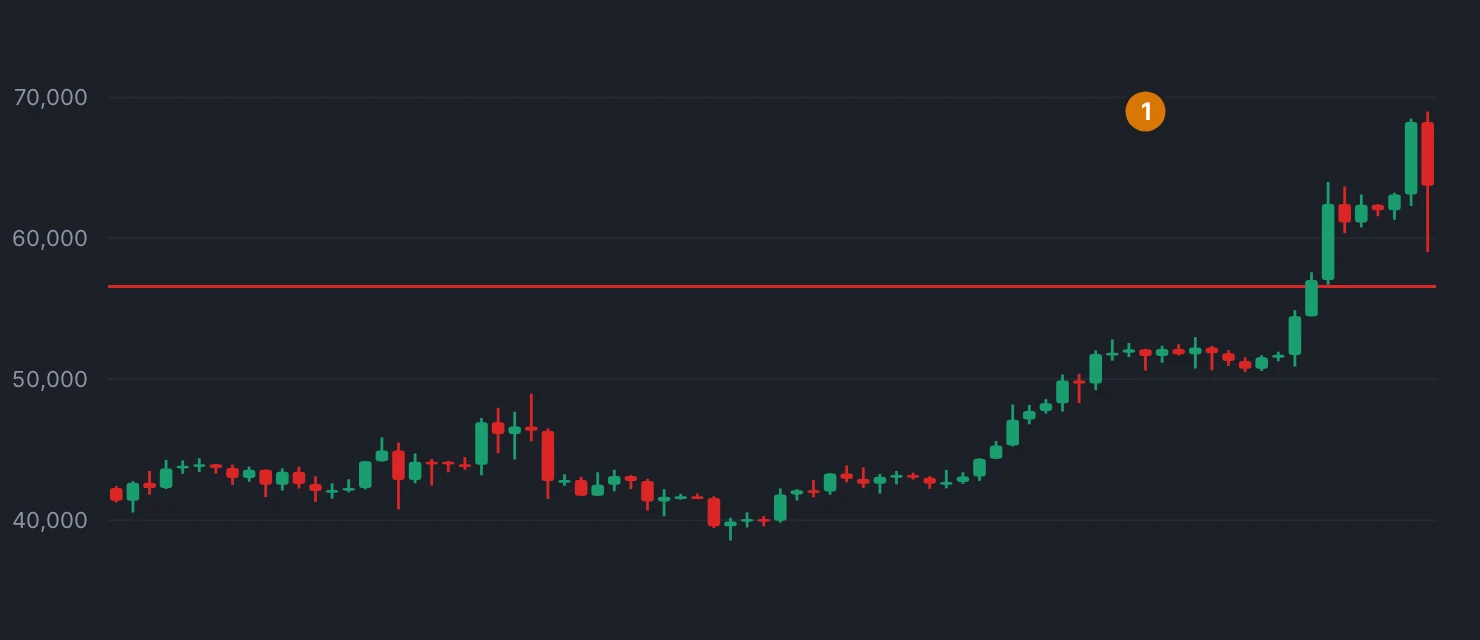
The chandelier part: it hangs from the high, not the entry
Here is the mechanic. The stop is placed 3 ATR below the highest price reached since the trade opened. As price makes new highs, the anchor rises and the stop rises with it. When price falls, the stop does not follow it down. It stays where it was.
That ratchet is the whole design. It converts an open profit into a floor. A position that has run a long way has a stop far above the entry price, which means the outcome is bounded even if the asset collapses from there.
Two consequences follow immediately, and both are uncomfortable.
You will always give back roughly 3 ATR from the peak. By construction, the exit cannot happen at the high. The high is the anchor. If a trend ends cleanly at a top, you exit 3 ATR below it, every time. That is not a flaw to be tuned away, it is the price of not having to predict tops.
The stop widens when volatility rises. ATR is recalculated, so a sudden expansion in daily range pushes the distance out. That keeps you in during violent but intact trends, and it also means the amount you are risking at that moment is larger than what you sized for at entry. If that bothers you, it should, and it is a genuine open tension in every ATR-based system.
How the stop feeds back into size
The exit rule is not just how you get out, it is how much you get in. Position size is derived from the initial stop distance so that hitting the stop costs a fixed percentage of equity, defaulting to 0.5% to 0.75% depending on style.
This is why a wider stop does not mean more risk. It means a smaller position. The two move against each other on purpose. A trader who widens a stop without shrinking size has quietly doubled their risk, which is one of the most common ways an otherwise reasonable plan stops working.
Indikora computes both together, so the stop and the size are never set by separate decisions made at separate moments. That is the only part of the mechanism that is really about discipline rather than math.
Where this exit performs badly
Sharp single-day reversals. A trend that ends with a violent gap can blow through the stop far below it. Stops are instructions, not guarantees.
Ranges. In a sideways market the stop trails up on a small rally, then gets hit on the fade, repeatedly. Every one of those is a small loss taken correctly by a rule that had nothing useful to work with.
Long, slow topping patterns. Price rolls over gradually, the stop stays anchored to a high set weeks ago, and you sit through a long decline before the level is reached.
A trailing stop is not a way to keep your profits. It is a way to make the size of the giveback known in advance instead of discovered afterward. Once you can state what a losing exit costs before you open the position, most of the emotional argument about when to sell disappears, because it has already been settled.
The chandelier stop trails 3 ATR below the highest price since entry and only ever ratchets up, which guarantees you give back part of every winner.
Check yourself
In bar replay, open one position and mark the chandelier stop level on every bar, then record the exact distance in percent between the peak price and your eventual exit.
Bar replayIndikora has a free simulator, bar replay and a behavioral coach that reads your own trades.
Open the app