
Risk per trade: the only number that keeps you alive
Almost nobody blows up an account on a bad idea. They blow it up on an ordinary idea, sized wrong, repeated eight times in a row while the market was not cooperating.
You have read that you should "manage risk". It is the most repeated and least specific sentence in trading. The specific version is a single number: the percentage of your equity you are willing to lose when a trade goes against you and your stop is hit. Everything else in this track is downstream of that number.
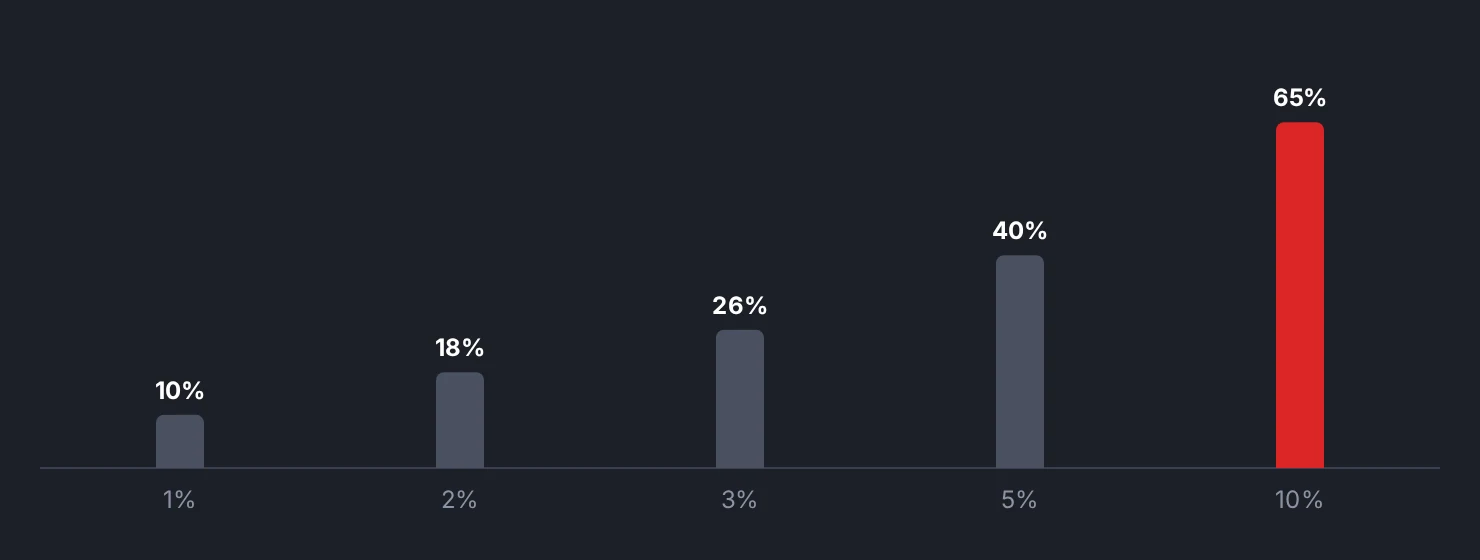
Run the losing streak, not the winning one
Take a 10,000 dollar account and imagine ten consecutive losses. Not a disaster scenario, just a bad month.
At 1% per trade, each loss is charged against the new, smaller balance. After ten losses you have 9,044 dollars. You are down 9.6% and you need a 10.6% gain to be flat again. That is a rough patch.
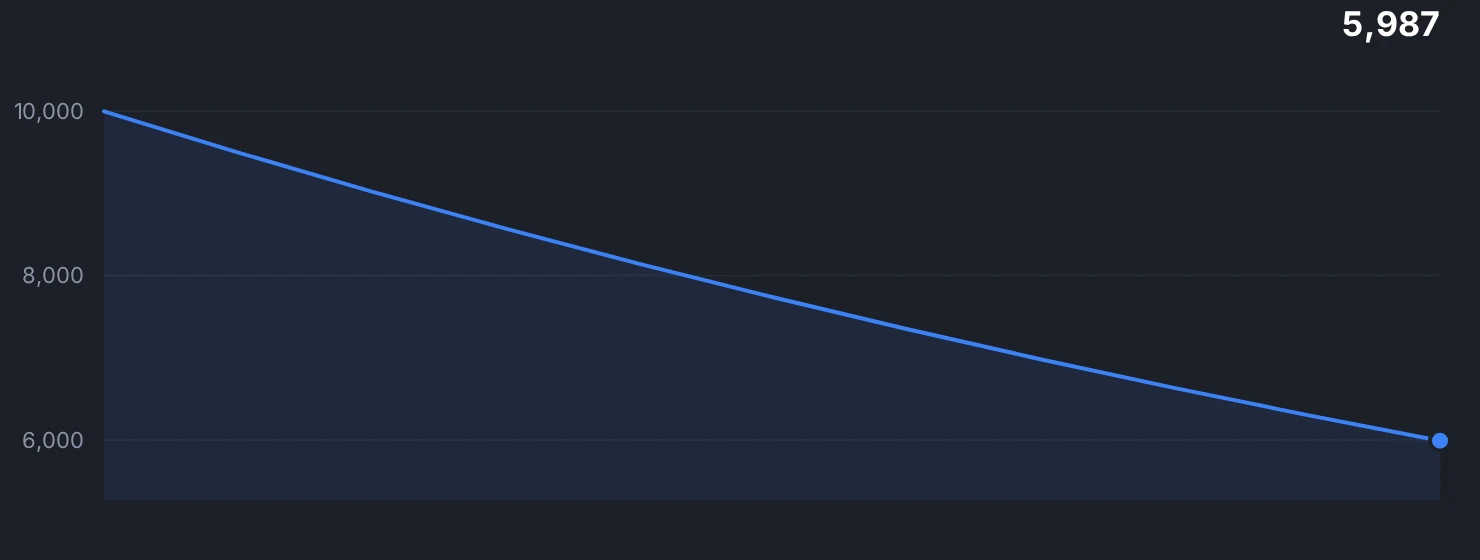
At 5% per trade, the same ten losses leave you with 5,987 dollars. You are down 40% and you need a 67% gain to get back. That is not a rough patch, that is a different account.
At 10% per trade, ten losses leave 3,487 dollars. Down 65%, and you now need to nearly triple what is left. The trades were identical in all three cases. Only the size changed.
A ten-loss streak is not rare, it is scheduled
Traders assume streaks like that are freak events. They are not. If your strategy wins 45% of the time, the chance of any specific ten trades all losing is 0.55 to the tenth power, which is about 0.25%. That sounds safe.
But you do not take ten trades. Over 200 trades, the chance that a ten-loss streak shows up somewhere in the sequence is roughly one in five. Over a few years of trading you should expect to meet one.
Position sizing is not about the trade you are placing. It is about the twenty trades after it. The number has to be small enough that the scheduled bad streak leaves you with an account, a strategy, and enough composure to keep following it.
Why small percentages feel wrong
Risking 0.75% of a 10,000 dollar account means putting 75 dollars at risk. On a good trade you might make 150 or 225 dollars. That feels pointless when you came here to change your financial situation.
This is the moment most accounts are decided. The trader raises the number to 5% because 75 dollars is "not worth the screen time", and for a while it works, because a positive run makes any size look brilliant. Then the streak arrives and takes 40%.
The small number is not modesty, it is the price of being able to compound at all. A 0.4R average edge on 200 trades at 0.75% risk is a meaningful annual return. The same edge at 5% risk usually never gets to trade 200 times.
Percent of equity, not a fixed dollar amount
There are two ways to fix the number, and they behave very differently.
Fixed dollar risk means always risking 100 dollars. It is simple, but it does not shrink when you are losing. On a 10,000 dollar account that is 1%. After a 40% drawdown it is 1.67% of what is left, so the account bleeds faster exactly when it can least afford to.
Fixed fractional risk means always risking 0.75% of current equity. At 10,000 dollars that is 75 dollars. At 8,000 dollars it is 60 dollars. The size falls automatically during a drawdown and rises during a run. It is mathematically impossible to reach zero with fixed fractional risk, though you can certainly reach an amount too small to be worth trading.
Indikora defaults risk per trade to between 0.5% and 0.75% of equity depending on the selected style, and derives the position size from that, never the other way around.
The number comes first
The order of operations matters more than the number itself. Most people pick a position size that feels right, place the stop wherever the chart suggests, and discover their risk afterwards. That produces a portfolio where one trade risks 0.3% and the next risks 4%, with no decision ever having been made about it.
Reverse it. Decide the percentage once, in advance, when no position is open and nothing is at stake. Then let the chart decide the stop, and let arithmetic decide the size. The next lesson does exactly that calculation, end to end.
Your risk per trade is not a preference, it is the number that decides whether a normal losing streak is an inconvenience or the end of the account.
Check yourself
Enter your real account balance in the position-size calculator at 1%, 3% and 5% risk, and write down what each setting leaves you with after ten consecutive losses.
Position calculatorIndikora has a free simulator, bar replay and a behavioral coach that reads your own trades.
Open the app