
Choosing a style, from conservative to momentum
The word "aggressive" does most of the damage here. It sounds like a setting for people who are good at this, and "conservative" sounds like the beginner option you graduate out of. Neither is true, and reading the labels that way leads people to pick the setting that describes the trader they want to be rather than the one they are.
A style in Indikora changes three concrete things: which moving average the BTC regime gate uses, what percentage of equity is risked per trade, and consequently how many entries you see. It does not change the trend definition and it does not change the exit rule. SMA50, 28-day momentum and the 3 ATR chandelier stop are identical across all four.
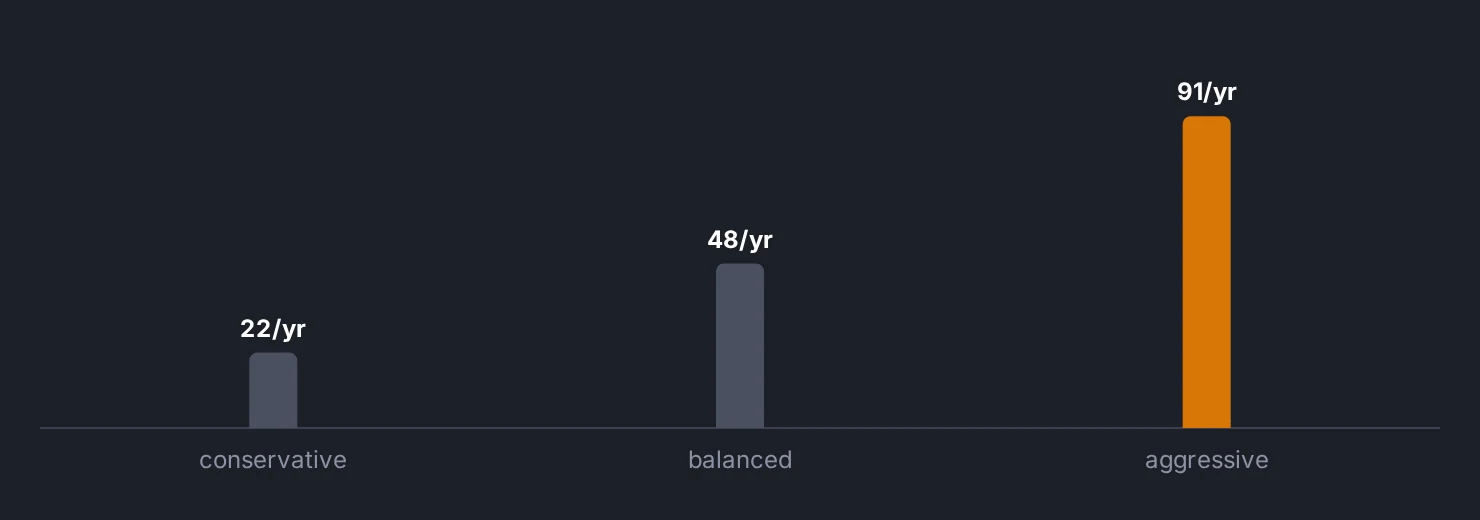
What each style sets
Conservative gates new crypto entries on Bitcoin above its 200-day average and sits at the low end of the risk range, near 0.5% of equity per trade. Fewest entries, smallest individual mistakes, longest stretches of doing nothing.
Balanced uses the 100-day average for the gate, with risk in the middle of the range. It turns back on after a decline noticeably earlier than conservative does.
Aggressive uses the 50-day average and the upper end of the range, near 0.75%. It reacts fastest to a change in market state and flips state most often.
Momentum applies no BTC veto at all. Assets are judged only on their own trend conditions, which means crypto entries can fire in the middle of a broad market decline.
Notice what is not on that list. There is no style that changes the stop, no style that changes what counts as a trend, and no style that predicts better. The dial controls exposure, not accuracy.
The two tradeoffs, stated directly
More participation means more false starts. A faster regime setting is in the market during more of every recovery, and also during more of every failed rally. Those are the same property. You cannot buy earlier participation without buying the entries that turn out to be early for the wrong reason. Anyone who tells you a setting gives more upside without more of that is selling something.
Higher risk per trade compounds in both directions. The difference between 0.5% and 0.75% sounds trivial and is not. It is a 50% increase in the size of every loss and every win. Across a losing streak of eight trades, that is the difference between being down 4% and being down 6% of equity, and the larger loss also makes the next decision harder to take calmly.
There is a third effect that is easy to miss. Style changes how often you have to do nothing. Conservative will produce long periods with no new entries, sometimes months. That is the mechanism working as designed, and it is also the single most common reason people abandon a system. The setting that suits you is the one whose quiet periods you can actually sit through without overriding it.
Backtests will not answer this for you
It is reasonable to ask which style tested best. It is also the wrong question, and the honest answer is that a backtest of these settings measures something narrower than most people assume.
A test measures how a fixed set of rules would have behaved over a specific historical window, with assumptions about fills and costs. It tells you the shape of the behavior: how often entries fired, how long positions lasted, how deep the drawdowns ran, how the four settings differed in those terms.
What it cannot tell you is which style will suit the next few years, because the number of independent market cycles in the sample is small. A setting that looks best over one window very often looks best because that window contained the conditions it happens to suit. Choosing on the strength of a headline result from a small sample is how people end up with a setting they abandon at the first drawdown that does not match the test.
That is why Indikora publishes calibration and a chained record of signals instead of a performance number. You can check whether stated probabilities matched outcomes. That is a testable claim. "This style is better" is not.
How to actually choose
Not advice about markets, just a way of thinking about the setting itself.
Start from your tolerance for inactivity, not your return target. If long flat stretches make you override the system, the slow settings will not work for you no matter how they tested.
Then decide what a bad month may cost. Multiply the risk per trade by a realistic losing streak length and look at that number honestly before it happens rather than after.
Then change one thing at a time. Switching style mid-drawdown resets the evidence you were gathering about yourself, and it is almost always a reaction rather than a decision. The journal exists partly so you can tell those apart later.
A style is a statement about how you want to be exposed, not a prediction about which exposure will pay. The engine has no opinion about which one you should pick, and that is deliberate. It can tell you exactly what each one does. What you can tolerate is the part only you have the data on.
A style is not a performance dial, it is a choice about how often you are in the market and how large each mistake is.
Check yourself
Run the same asset and entry in the simulator twice, once sized at 0.5% risk and once at 0.75%, and write down the account value at the stop-out in both cases.
SimulatorIndikora has a free simulator, bar replay and a behavioral coach that reads your own trades.
Open the app