
Where to actually put a stop
Ask ten traders where they put their stop and most will answer with a percentage. Two percent below entry. Fifty dollars. Under the round number. All of those answers have one thing in common: they describe the trader's tolerance, not the market's behavior.
The market does not know what you can afford. A stop placed at the distance you find comfortable will be hit at exactly the rate that distance is hit by noise, which has nothing to do with whether your idea was right.
The question a stop is answering
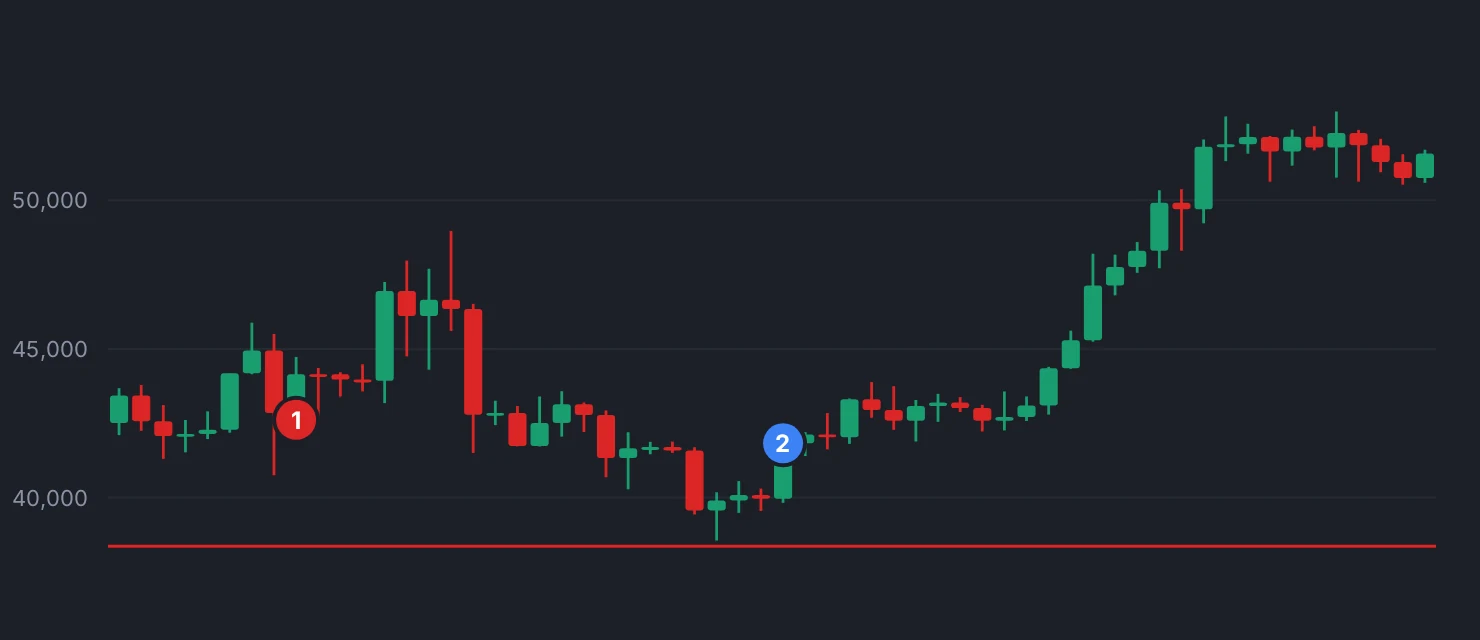
A stop is not a loss limiter. Position size is the loss limiter. A stop is a statement: at this price, the reason I took this trade is no longer true.
If you entered because price was holding above a level that had been defended three times, then the stop belongs below that level, because a close underneath it means the thing you observed is over. If you entered because an asset was in its own uptrend on the daily, then the stop belongs where that uptrend stops being visible.
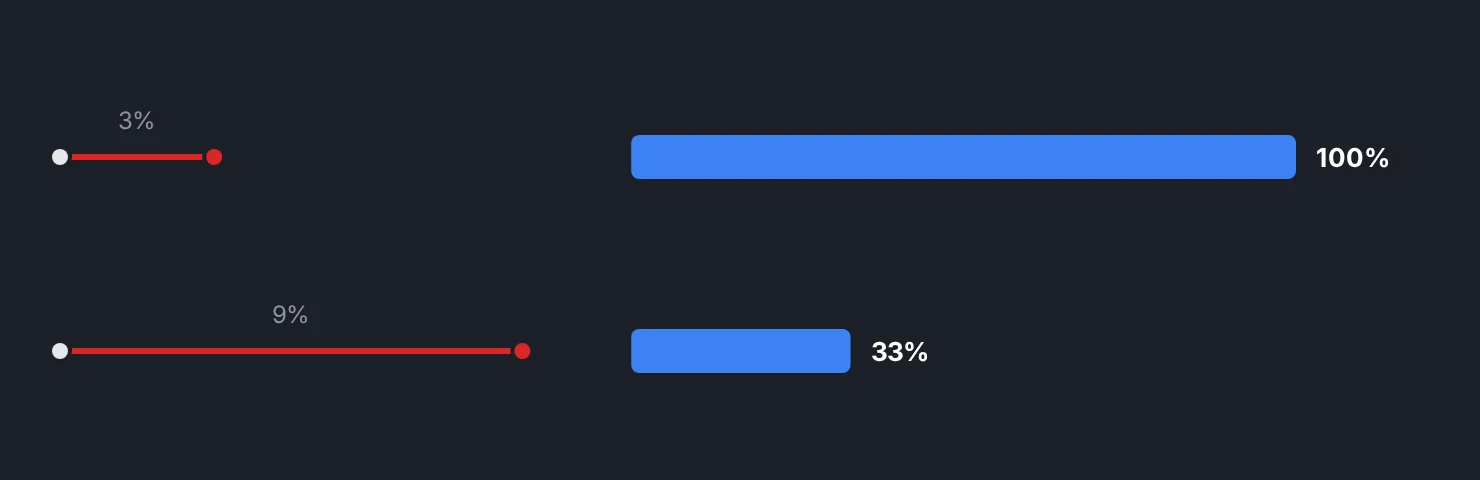
Once you write the stop that way, the distance is whatever it is. Sometimes it is 2%, sometimes it is 9%. The size absorbs the difference.
Volatility sets the floor
Two assets both trading near 48 dollars can need completely different stops.
Asset A has a 14-day ATR of 0.60. Its typical daily range is about 1.25% of price. Asset B has an ATR of 1.80, three times as much movement per day for the same price.
A 1.20 dollar stop on asset A sits two full average days away. It will only be reached by a genuine move. The same 1.20 dollar stop on asset B sits at two thirds of a single average day. Asset B will trade through it on a quiet Tuesday, with no news, while the trend is intact.
The floor for a stop is set by how much the asset moves when nothing is happening. A common way to express that is a multiple of ATR. Indikora uses 3 x ATR below the highest price reached since entry, which on asset B is 5.40 dollars and on asset A is 1.80 dollars.
Do the sizing math both ways
Account 10,000 dollars, risk 0.75%, so 75 dollars.
Asset B with the 5.40 stop: 75 / 5.40 = 13.9, so 13 shares. Position value 13 x 48 = 624 dollars.
Asset B with an aggressive 1.80 stop: 75 / 1.80 = 41.7, so 41 shares. Position value 1,968 dollars.
Both trades risk about 75 dollars. The second one is three times the exposure and will be stopped out far more often, on the same idea, for the same reason. The tight stop did not reduce risk, it converted risk from size into frequency. Lesson 9 goes through why that trade usually comes out worse.
Trailing: locking in without strangling
A fixed stop answers "was I wrong". A trailing stop answers "is it still working". They are different jobs and most systems need both.
A chandelier stop is one common construction: take the highest price reached since you entered, subtract 3 x ATR, and never move that level down. If you enter asset B at 48 with ATR 1.80, the initial stop is at 42.60. If price runs to 56, the stop follows to 50.60 and is now above entry. The trade cannot lose from that point unless it gaps.
Two properties are worth noticing. The stop only ratchets up, so the trade always keeps its room in a pullback. And because the distance is tied to ATR, it automatically widens in violent markets and tightens in calm ones, without you deciding anything under pressure.
The things that quietly ruin stop placement
Putting it at the obvious level. If the whole chart can see the swing low at 44.00, a large number of stops are sitting just underneath. Price reaching 43.80 and reversing is not a conspiracy, it is a liquidity pocket doing what liquidity pockets do. Placing your stop a fraction beyond the obvious level costs a little size and removes a whole category of frustrating exits.
Moving it once the trade is live. Widening a stop because price is approaching it is the single most expensive habit in retail trading. It converts a known 75 dollar loss into an unknown one, and it is almost always the moment your position sizing stopped being real.
Mental stops. A stop you have not entered is a plan you will renegotiate at the worst possible moment. The whole point of deciding in advance is that the version of you deciding is calm.
What good looks like
You should be able to explain the stop before the entry, in one sentence, referring to the market and not to your account. "Below the level that has held three times, plus a buffer" is a stop. "Fifty dollars" is a budget wearing a stop's clothes.
Then take whatever distance that sentence produces and let it set the size. If the resulting position is uncomfortably small, the stop is telling you something honest about the volatility you were about to take on.
A stop marks the price at which your reason for being in the trade stopped being true, and the size adjusts to whatever that distance turns out to be.
Check yourself
In bar replay, mark an entry and write down both a 1 x ATR and a 3 x ATR stop, then step forward twenty bars and record which one was hit and whether the original reason for the trade had actually failed.
Bar replayIndikora has a free simulator, bar replay and a behavioral coach that reads your own trades.
Open the app