
Loss aversion: why you cut winners and hold losers
Your win rate is 68%. You still lost money last quarter. That combination is not bad luck, it is a signature, and it points at one specific thing.
You closed the green trades at +0.4R and let the red ones run to -1.8R. Two out of three trades were right and the average size of being right was a third of the average size of being wrong. Nothing about your analysis was the problem.
The mechanism, briefly
Losing a given amount registers roughly twice as strongly as gaining the same amount. That asymmetry has been measured repeatedly and it is not a personal weakness, it is close to standard equipment.
Two consequences follow directly, and they push in opposite directions.
An open profit becomes something you can lose. Once the trade is up 0.5R, that 0.5R feels like it belongs to you, and giving it back would be a loss. So you close it, and the discomfort ends immediately. The relief is real and it reinforces the behavior every time.
An open loss stays hypothetical until you close it. While the position is live, you have not lost, you are down. Closing converts a fluctuating number into a permanent fact, and the mind resists that conversion hard. So you wait, and you find reasons to wait.
This pair has a name in the research literature, the disposition effect, and it shows up in retail brokerage data across every market anyone has looked at.
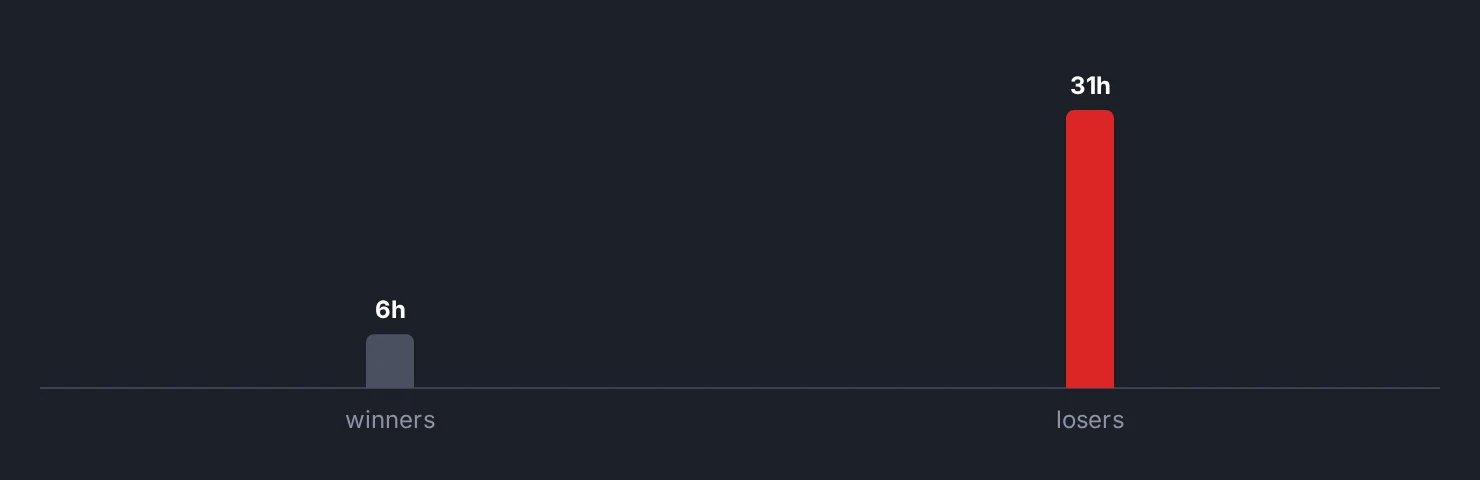
How it disguises itself as analysis
You rarely experience this as fear. It arrives dressed as reasoning, and the reasoning is usually locally plausible.
"I'll take profit here, the level ahead looks strong." Sometimes true. But check whether you say it more often when the trade is green than when you planned the level in advance.
"The stop was too tight, the structure is still valid." Occasionally true and usually said only after price has already gone through the level.
"I'll add here, the average entry improves." Averaging into a losing position increases risk on the thesis that is currently failing. That may be a legitimate strategy if it was planned before entry with the size reserved for it. If it appears after the loss opens, it is the effect, not a plan.
The diagnostic is timing. Any exit rule invented while the position is open is suspect. Rules created before entry are decisions. Rules created during a trade are usually rationalizations with a chart attached.
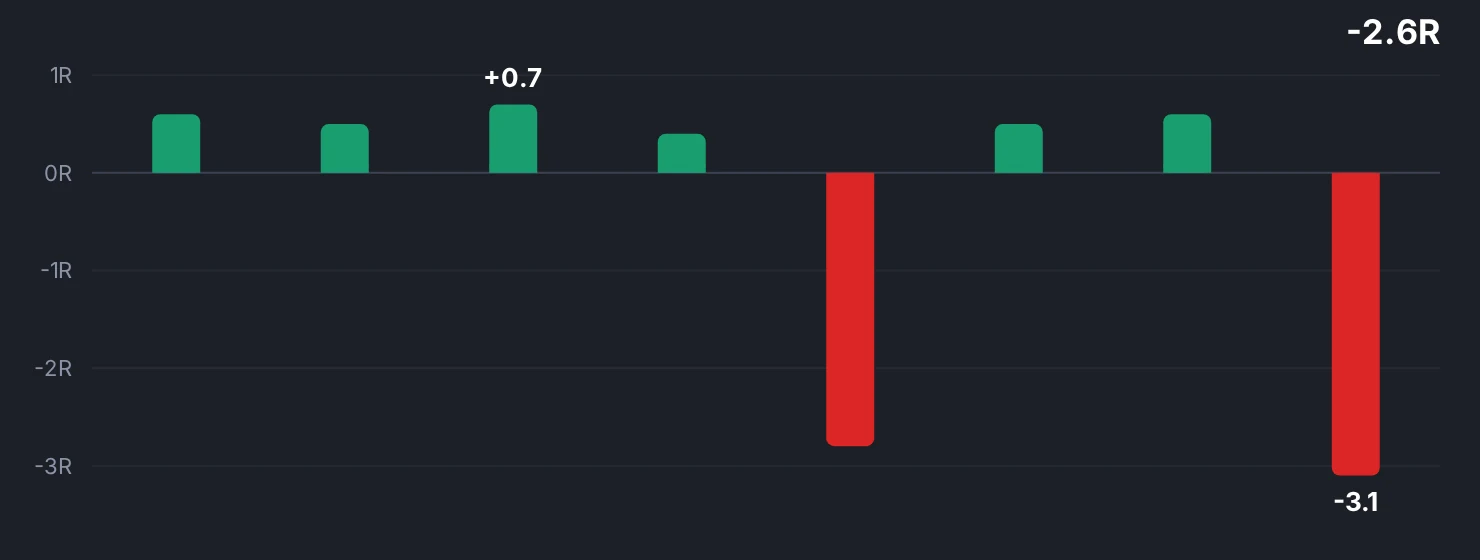
What the numbers require
You can win less than half your trades and still do well, provided the sizes are asymmetric.
At a 40% win rate with 3R winners and 1R losers: 100 trades gives 40 x 3 = 120R won and 60 x 1 = 60R lost, for +60R. At a 70% win rate with 0.4R winners and 1.5R losers: 70 x 0.4 = 28R won and 30 x 1.5 = 45R lost, for -17R.
Win rate is the number that feels like performance and the one that matters least. The distribution of R is the thing. Loss aversion attacks exactly that distribution, from both ends at once, which is why it is more damaging than any single bad entry.
The countermeasure: pre-commit both exits
The rule is simple to state and uncomfortable to follow. Before you enter, you write down where the idea is wrong and where you would take profit, and both are placed as orders rather than intentions.
A stop in the market, not in your head. A mental stop is not a stop, it is a plan to make a decision at the worst moment. Once the order is resting, the exit no longer requires you to convert a fluctuating number into a fact.
A trailing rule rather than a discretionary target. The reason to trail is that it removes the "take it now" decision without capping the upside. Indikora uses a chandelier stop: the highest price since entry minus 3 x ATR. It moves up and never down, so the trade closes itself when the move ends rather than when your discomfort peaks. Wider volatility gives a wider stop and, because position size is derived from stop distance at a fixed 0.5% to 0.75% risk, a smaller position.
One binding rule: never widen a stop. Tightening is a judgment call you can argue about. Widening is always the effect operating. Make it something your process does not permit.
Then measure it. Track average win in R and average loss in R separately. If your average loss is larger than your average win while your win rate is high, you have found the thing, and no entry improvement will fix it.
Indikora's Coach classifies each decision as rational, FOMO, revenge, fatigue, overconfidence or overtrading, which catches the entries. The exits are yours to measure, and the two averages are the whole measurement.
The trade is decided before it starts
The useful shift is to treat entry as the last moment you have full judgment. After that, price is moving, money is at stake, and the asymmetry is running. Everything you decide from that point is decided by a version of you with a thumb on the scale.
Write both exits down while nothing is at stake, put them in the market, and let the trade resolve. Your win rate may fall. The number that matters is the one that will not.
Losses feel roughly twice as strong as equivalent gains, which pushes you to bank small winners and hold large losers, and the only durable fix is deciding both exits before entry.
Check yourself
Compute your average winner and average loser in R separately across your last 50 closed trades, and count how many losers were closed beyond the stop level you originally set.
Trade journalIndikora has a free simulator, bar replay and a behavioral coach that reads your own trades.
Open the app