
Pullbacks: buying weakness inside strength
Waiting for a pullback feels like the disciplined choice. You do not chase, you get a better price, your stop is closer, and the arithmetic of risk improves on every trade you take.
Then the trend you were waiting on runs 20% without ever giving you the entry you wanted, and the one pullback you do get keeps going and turns into a full reversal. The trade-off nobody mentions is that pullback entries improve the trades you take and remove some of the best ones entirely. Whether that is a good deal depends on details most people never measure.
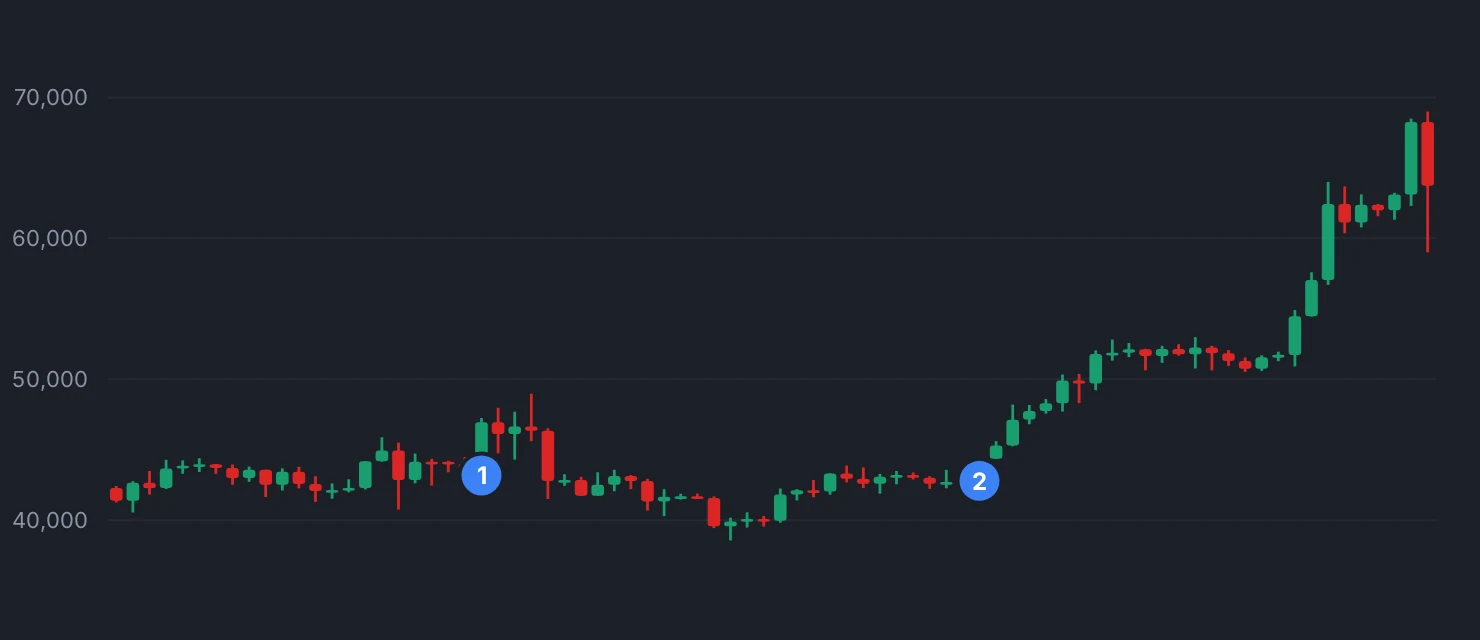
A pullback and a reversal are the same thing until one of them stops
This is the part that cannot be engineered away. At the moment you are deciding, a healthy retracement inside a trend and the first leg of a trend ending produce the same chart: price coming down after an advance, sentiment turning, the last few bars red.
There is no indicator, candle pattern, or retracement level that distinguishes them in real time. The distinction is only available afterward, when price either resumes or does not.
Once you accept that, the question changes usefully. It stops being "how do I identify a real pullback" and becomes "where can I be wrong cheaply, and how often does this need to work."
What the entry actually buys you
The mechanical benefit is stop distance. If a trend entry near the highs needs a stop 3 ATR away and a pullback entry into the prior structure needs one 1.5 ATR away, you can hold twice the position for the same money at risk, and the same subsequent move produces twice the R.
That is a real, arithmetic edge, and it is the entire case for pullback entries. It is not about being smarter or more patient. It is about the ratio between where you enter and where the idea becomes wrong.
The cost is selection. Trends that move most violently often do not retrace enough to fill you, so a pullback rule systematically filters out a subset of moves that includes some of the largest ones. That is a survivorship problem in your own trade log: the trades you took look good, and the ones the rule silently excluded are invisible.
Defining the pullback before you see it
Because you cannot tell a pullback from a reversal, the definition has to be written in advance and applied without adjustment.
Depth. How far back into the prior leg are you willing to buy. Shallow retracements keep the stop tight but fill rarely. Deep retracements fill often but the stop has to sit below meaningful structure, which erodes the arithmetic advantage that motivated the entry.
Structure, not levels. The 61.8% retracement is not a physical property of markets. It is a number that many people watch, which gives it some self-fulfilling effect at times and none at others. A prior swing low, a consolidation shelf, or the area where the last breakout occurred are structural facts about where transactions happened. Prefer those.
Time. A retracement that takes three bars behaves differently from one that takes three weeks. A pullback grinding sideways for a long time is a range forming inside what used to be a trend, and treating it as a dip is how people end up long in a topping structure.
Invalidation first. Write the stop before the entry. If the stop sits below the level that would mean the trend structure is broken, the entry is defensible. If you had to place it somewhere arbitrary to keep the loss small, the entry is not defined - the loss size is.
The behavioral trap
Buying a pullback requires acting while the recent tape is against you. Every bar since you decided to wait has been red. The people around you sound cautious. Your last look at the chart made the trend look tired.
That is the definition of the entry, and it is also exactly the condition under which people talk themselves out of it or, worse, keep waiting for a slightly better price. The waiting is what usually costs money, because a deeper fill either never comes or comes with the trend genuinely broken.
Indikora's Coach exists partly for this. It classifies each trade decision as rational, FOMO, revenge, fatigue, overconfidence or overtrading, which makes visible the difference between a pullback you took because it met your rule and one you took because you had missed the initial move and wanted in.
How to know if pullback entries suit you
Measure both versions on your own history. Take fifty trend signals and record what would have happened with an entry at the signal and a 3 ATR stop, and what would have happened waiting for a defined pullback with a tighter stop, counting the signals that never filled as zero rather than deleting them.
The comparison only means something if the missed trades are included. Leaving them out is the most common way traders convince themselves pullback entries are strictly better.
Sometimes the tighter stop and larger size wins. Sometimes the missed runners dominate and immediate entry wins. Both outcomes are real, they differ by asset and by how trending the period was, and the only way to know which describes your market is to count.
A pullback and a reversal look identical while they are happening, so the entry has to be defined by structure and a stop, not by recognizing the difference.
Check yourself
Pick twenty trending charts in bar replay, write your pullback depth and stop level before stepping forward, and log how many filled, how many never retraced, and how many kept going past your stop.
Bar replayIndikora has a free simulator, bar replay and a behavioral coach that reads your own trades.
Open the app