
Why tighter stops usually hurt
You get stopped out. Twenty minutes later price turns around and goes exactly where you thought it would, without you. This happens often enough that most traders eventually conclude the market is hunting them personally.
It is not personal. It is that a tight stop sits inside the range the asset covers on an ordinary day, so it gets hit by noise rather than by your idea being wrong. The seduction of the tight stop is that it lets you trade a bigger position for the same money. That trade is available, and it is usually a bad one.
What tightening actually buys and sells
Take an asset at 48 with a 14-day ATR of 2.40. Your account is 10,000 dollars and risk per trade is 0.75%, so 75 dollars. Your objective for the move is 60.
Version A, structural stop at 44. Risk is 4.00 per share, size is 75 / 4.00 = 18 shares, and the 12 dollar move is a 3R target.
Version B, tight stop at 46. Risk is 2.00 per share, size is 37 shares, and the same 12 dollar move is now a 6R target.
Notice that R in dollars is 75 either way. Sizing absorbed the difference. So the two versions can be compared directly on expectancy.
Version B doubled your reward-to-risk without changing a single thing about the market. That is exactly why it is tempting, and exactly why it needs the second half of the sentence.
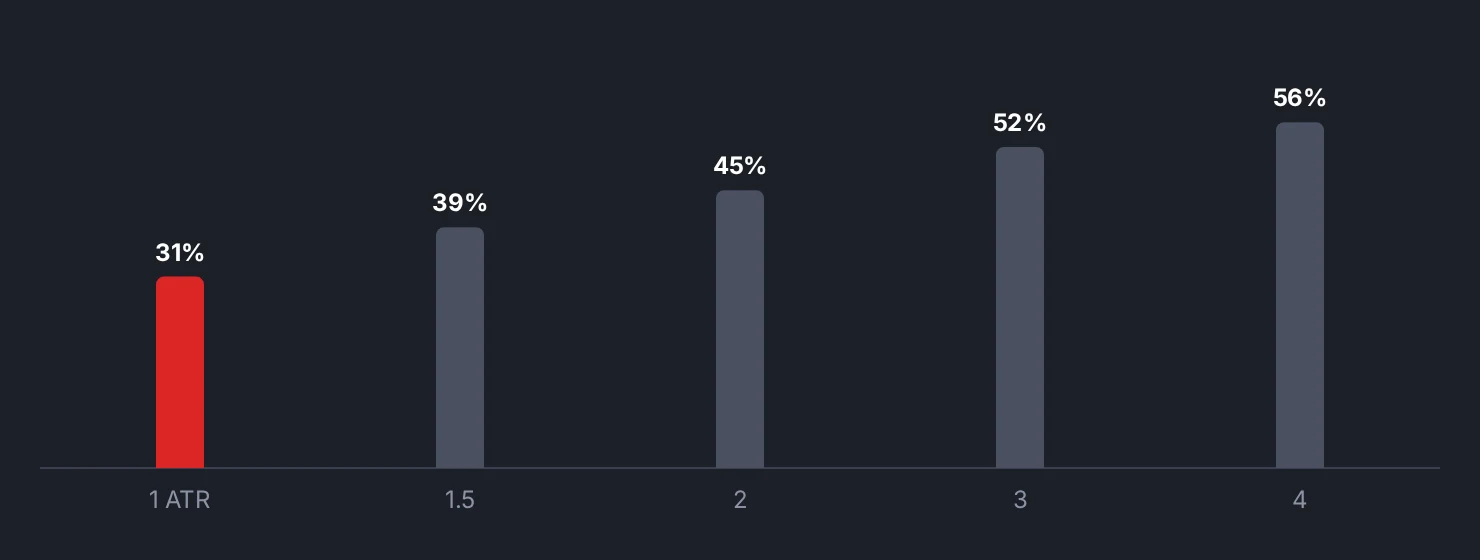
The win rate is the bill
Version A, at a 40% win rate:
0.40 x 3 - 0.60 x 1 = 1.20 - 0.60 = plus 0.60R, or 45 dollars per trade.
Version B needs only 14.3% to break even, since a 6R payoff breaks even at 1 / 7. So the question is what the tighter stop does to the hit rate.
At 22%: 0.22 x 6 - 0.78 x 1 = plus 0.54R, or 40.50 dollars. Slightly worse than A.
At 18%: 1.08 - 0.82 = plus 0.26R, or 19.50 dollars. Less than half of A.
At 15%: 0.90 - 0.85 = plus 0.05R, or 3.75 dollars. Effectively a break-even system that trades a lot.
The tight stop is 2.00 wide on an asset whose average day is 2.40. Being hit is not an exceptional event, it is the base case in any session where the asset simply does what it usually does. A win rate falling from 40% to 18% is not a pessimistic assumption for that change.
Costs are charged per share, not per R
The comparison above ignored friction, and friction is not neutral between the two versions.
Say the spread costs 0.05 per share and you pay it entering and exiting. Version A trades 18 shares, so 1.80 round trip, which is 2.4% of the 75 dollar R. Version B trades 37 shares, so 3.70, which is 4.9%.
Slippage behaves the same way. A stop fill that slips a tick costs twice as much on twice the size. And because version B is stopped out more often, it pays the round trip more times per unit of edge captured.
Tight stops pay more friction per trade and take more trades. Both effects push in the same direction.
The re-entry spiral
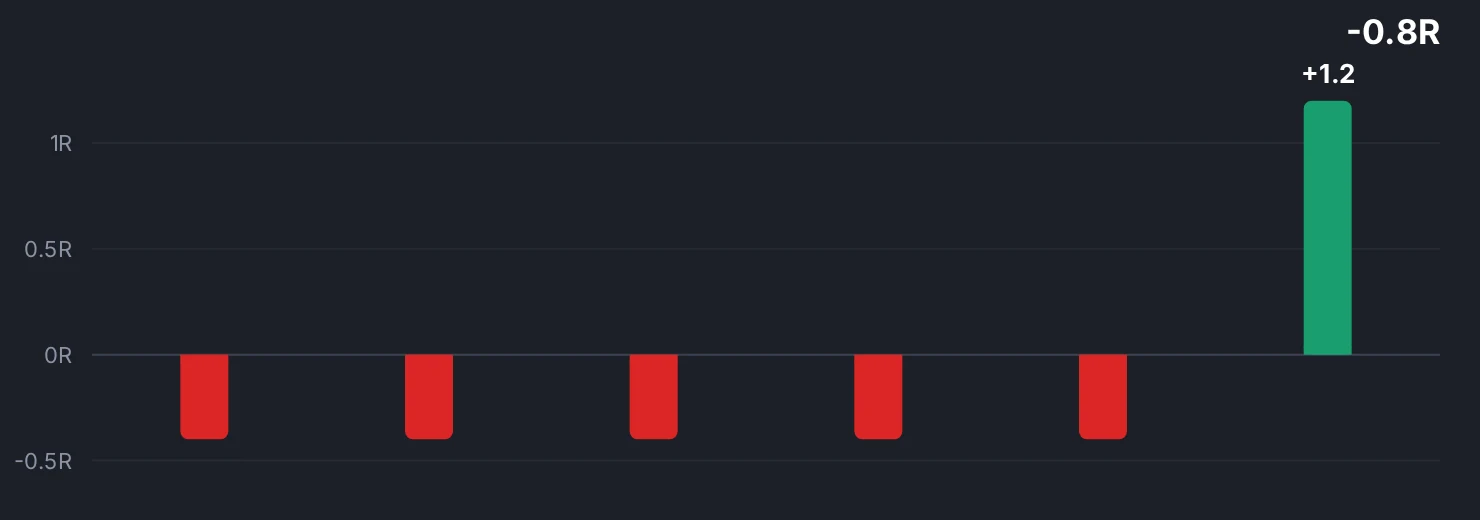
There is a second cost that does not appear in any spreadsheet. When a noise stop takes you out of a trade you still believe in, you re-enter. That re-entry costs another full R of risk on the same idea, and if it happens twice the original 3R target is now paying for 3R of accumulated stops.
This is where an expensive habit forms. The trader concludes that stops are the problem rather than stop placement, starts using mental stops, and eventually takes a loss with no defined size at all.
When a tight stop is correct
None of this says tight stops are wrong. It says stops set by your appetite rather than by the market are wrong.
If you enter right at the level that invalidates the idea, your stop is legitimately close, because the distance to invalidation is genuinely small. That is a tight stop earned by the entry, and the resulting large position is appropriate. The failure mode is entering far from invalidation and then placing a stop close anyway because the arithmetic gives a nicer position size.
The test is simple. Ask what has to happen for the stop to be hit. If the honest answer is "an ordinary Tuesday", the stop is inside the noise. If it is "the level breaks", the stop is doing its job.
Indikora places its exit at 3 x ATR below the highest price since entry, which on this asset is 7.20 wide. That is far looser than most retail traders are comfortable with, and the position it produces is correspondingly small. The looseness is the point: the stop is meant to be reached by a change in the trend, not by a normal day.
A tighter stop buys you a bigger R-multiple and charges you a lower win rate, and the win rate usually falls faster than the multiple rises.
Check yourself
Run the same setup twice in the simulator, once with a 1 x ATR stop and once with a 3 x ATR stop at identical dollar risk, and compare the win rate and total R after twenty trades.
SimulatorIndikora has a free simulator, bar replay and a behavioral coach that reads your own trades.
Open the app