
Portfolio heat: capping your total exposure
Per-trade risk is a solved problem by this point in the track. You risk 0.75% of equity, the stop sets the size, and no single trade can hurt you.
Then you take eight of them. Now 6% of the account is on the line simultaneously, and on the kind of day where correlations converge, all eight can resolve together. Nothing in your per-trade rule prevented that, because a per-trade rule only ever looks at one trade.
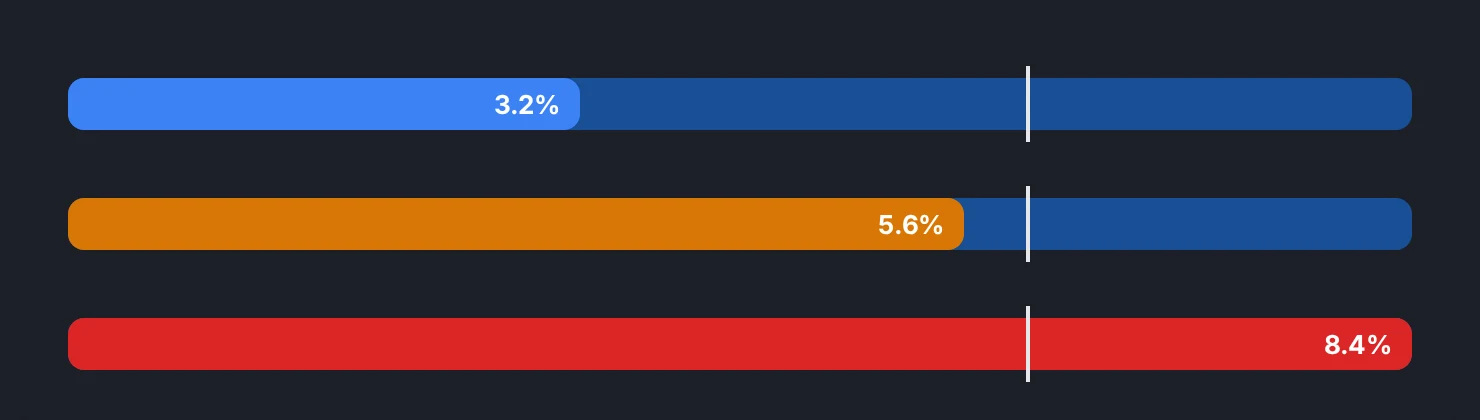
Portfolio heat is the missing constraint: the total risk currently live across every open position, expressed as a percentage of equity.
Computing it, and the distinction that matters
Heat is the sum, over open positions, of (current price minus current stop) x size, divided by equity.
The word "current" is doing the work. Two versions of the number exist and traders conflate them.
Initial heat is what you committed when you opened everything. Eight positions at 0.75% is 6.0%.
Live heat is what those positions would actually cost from here. Suppose three of the eight have run and their trailing stops now sit above entry. Those three cannot lose money, so they contribute zero. Live heat is 5 x 0.75% = 3.75%.
That difference is not bookkeeping, it is capacity. A book with trailing stops sheds heat as it works, which is what creates room for the next position without raising total exposure. Indikora's chandelier stop, which ratchets up to 3 x ATR below the highest price since entry and never moves down, does this mechanically.
Setting the cap
A cap is three numbers, decided when nothing is open.
Total heat cap. Common practice sits between 4% and 8% of equity. At 6% with 0.75% positions, that is eight full-risk positions at once.
Per-bucket cap. Group by driver, not by ticker: crypto beta, dollar direction, equity beta, rates. A 3% bucket cap means four crypto positions maximum, no matter how many setups appear. This is where the correlation lesson becomes operational.
Per-position cap. Your standard risk per trade, 0.5% to 0.75%.
Once the caps exist, the next setup gets evaluated against remaining capacity rather than against its own merits alone.
What it does on the day everything triggers
The scenario that portfolio heat exists for is the broad breakout. A single macro event turns twelve instruments eligible on the same morning.
Without a cap, you enter all twelve at 0.75%. That is 9% heat on a 10,000 dollar account, or 900 dollars of open risk, and every position was triggered by the same catalyst. If the move fails and all twelve reverse, you lose 900 dollars in a session. Add gap slippage of even 20% beyond the stops and it is closer to 1,080 dollars, more than a tenth of the account, on one day, from following your per-trade rule perfectly.
With a 6% total cap and a 3% crypto bucket cap, the same morning produces four crypto entries and four others, 600 dollars of open risk, and the remaining setups are simply not taken.
The setups you skip are not a cost, they are the product. You cannot have a hard aggregate limit without declining trades that pass every individual filter.
When you are close to the cap
The awkward case is a good setup when heat is at 5.4% against a 6% cap. Two coherent answers exist and both are better than the improvised one.
Skip it. Simplest, and defensible. Setups recur.
Scale it. Take the position at the remaining 0.6% instead of 0.75%, which is 80% of normal size. The rule stays intact and the trade is in the book at a size the cap can carry.
The improvised answer, which is to take it at full size because this one looks better than the others, is how the cap stops being a cap. A limit you override on conviction is not a limit, it is a preference.
What people get wrong
Counting positions instead of risk. "No more than six open" is not a heat rule. Six positions with wide stops and six with tight ones carry the same heat only if the sizing was done correctly, and if it was, the position count is irrelevant anyway.
Ignoring gap risk. Heat assumes stops fill at the stop. Over a weekend or an earnings date, they do not. Some traders run a stressed version of heat, multiplying open risk by 1.3, and cap that instead.
Forgetting the drawdown interaction. Heat is a percentage of current equity. After a 15% drawdown, 6% heat is a smaller dollar figure automatically, which is correct: exposure should contract when the account does.
The number to keep visible
Heat is the only risk statistic that answers the question you actually face all day, which is whether to take the next trade. Per-trade risk answers how big. Expectancy answers whether the system works. Heat answers whether there is room right now.
Keep it on screen. If you cannot state your live heat within a few tenths of a percent at any moment, you do not know what you are exposed to.
Portfolio heat is the sum of what all your open positions would cost you today, and it is a cap you set in advance rather than a number you discover.
Check yourself
Calculate your live portfolio heat right now from your open positions, split it by driver bucket, and write down the total and per-bucket caps you will apply from here.
Trade journalIndikora has a free simulator, bar replay and a behavioral coach that reads your own trades.
Open the app