
The journal: what gets recorded, and why
Almost everyone has started a trading journal. Almost nobody has one that is more than a few weeks long. The reason is not laziness. It is that the journal most people build records the wrong things, produces nothing useful when reread, and so quietly stops being worth the five minutes.
The typical failed journal is a list of trades with prices, outcomes, and a comment written after the close. A comment written after the close is not evidence, it is a story. By then you know the result, and the human brain reconstructs the reasoning to match. "I should have held" and "I got lucky" are both narratives assembled from an outcome you already possess.
A journal earns its keep only if some part of it is fixed before the outcome exists.
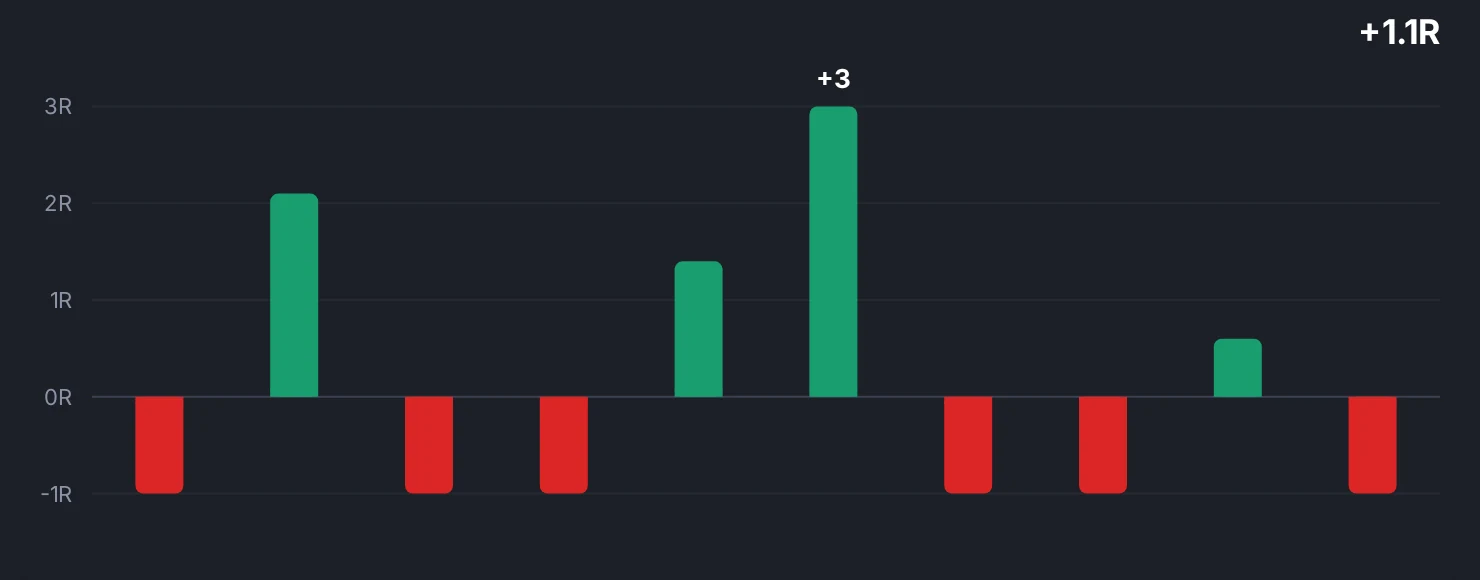
What Indikora records without you
The mechanical layer is captured automatically, because it is exactly the part people record inconsistently and exactly the part that has to be exact.
For every closed trade: entry price and timestamp, exit price and timestamp, the initial stop distance, the position size, the risk taken as a percentage of equity, the result expressed in R, the asset, and the style that was active. Plus the state of the rules at entry: whether price was above SMA50, the value of 28-day momentum, and where the BTC regime gate stood if it applied.
That last group is the part that makes the difference. Recording the rule state at entry lets you separate two very different failures later: the trade that followed the rules and lost, and the trade that lost because you were not following them. Those look identical in a plain profit-and-loss list, and they require opposite responses.
The Coach's classification of the decision is attached as well, so each closed trade carries a label describing the circumstances it was taken in.
What only you can add
Everything above is fact. None of it is why.
The note field is for what you believed at the time. Not a prediction and not a target, which are both forms of forecasting the journal has no use for. What you were reacting to. What you had just read. Whether you were calm. Whether this was the trade you planned that morning or one you found while looking at something else.
Tags are for grouping. Free-form labels you invent for yourself: the market condition, your state, the specific setup, whatever categories your own mistakes actually fall into. The point of a tag is that six months later you can filter on it and see fifteen trades that share a property, which is the smallest sample where a pattern starts being visible at all.
The reason this cannot be automated is that the engine has no access to your reasoning. It sees the fill. It does not see the thirty seconds before the fill, and those thirty seconds are where the useful information usually is.
The review that actually finds something
Rereading trades chronologically is how journals die. It produces the feeling of diligence and no findings.
Filter instead. Pull every trade with one tag and read only those. Pull every trade labeled revenge and look at the R distribution. Pull every trade taken while the regime gate was closed, if your style permits any, and compare them to the rest.
Compare rule-following losses to rule-breaking losses separately. A system that loses on trades that followed the rules is behaving as designed, because losses are part of the design. A system that loses mostly on trades that broke the rules has a different problem entirely, and it is not the system.
Look for the note you wrote before the outcome. The most valuable entries are the ones where you recorded a reservation and traded anyway. Those are the only direct evidence you will ever get that you knew something and overrode it, and they are impossible to reconstruct from memory because memory deletes them.
What a journal is not
It is not a performance report. Counting winners tells you almost nothing over the sample sizes an individual trader accumulates, and a run of luck in either direction can dominate a hundred trades.
It is not a place for conclusions about markets. "Gold reverses on Fridays" from eleven observations is noise with a sentence wrapped around it.
And it is not a substitute for the rules. The journal measures whether you executed a plan. It does not create one. If there is no written rule, there is nothing for the entry to be compared against, and the whole exercise collapses back into narrating outcomes.
The uncomfortable truth is that most of what a journal reveals is not about markets at all. It is a record of the gap between what you said you would do and what you did, in your own handwriting, with dates. That gap is the only thing in trading that is fully under your control, and it is invisible without a written record made before you knew how the story ended.
The only journal entry worth writing is the one made before the outcome exists, because everything written afterward is a story built to fit the result.
Check yourself
Filter your journal to every trade carrying one single tag, read only those, and write one sentence describing what they have in common that the numbers alone do not show.
Trade journalIndikora has a free simulator, bar replay and a behavioral coach that reads your own trades.
Open the app