
FOMO: buying after the move has happened
You watched something go up 9% while you were deciding. By the time you clicked, it was 12%. Then it pulled back 5%, took your stop, and continued without you.
The frustrating part is that your read was right. You identified the move. You just paid for it at the point where the risk was largest and the remaining distance was smallest, and the market does not award points for having been early in your head.
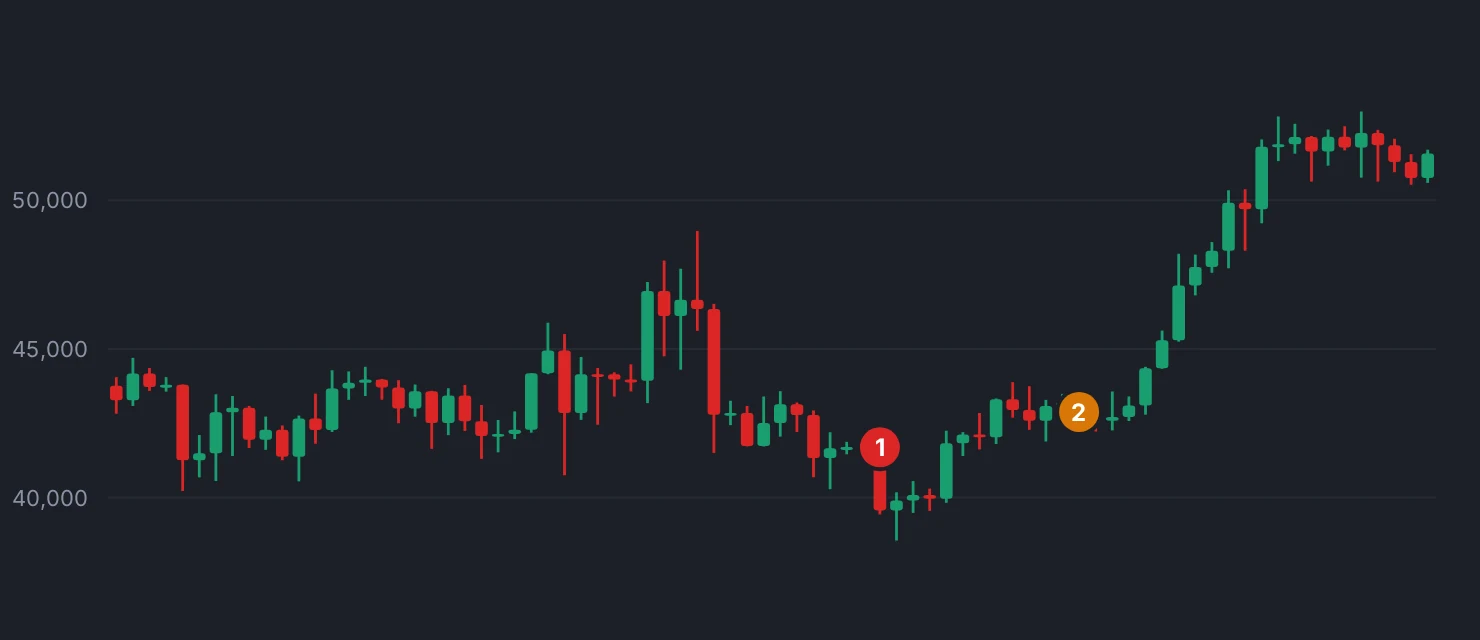
What FOMO actually costs you
The usual complaint about chasing is "you bought the top". That is sometimes true, but it is not the mechanism that hurts most often. The real cost is structural, and it shows up in the numbers before it shows up in the outcome.
A late entry sits far from any level that would invalidate the idea. If the move started at 100 and the sensible invalidation is back below 98, entering at 101 gives you a 3% stop. Entering at 112 gives you a 12.5% stop for the same idea. Same thesis, four times the risk per unit.
You then get two bad options. Keep the stop where the idea actually breaks and accept a much smaller position, which means the trade barely matters even when it works. Or move the stop up close to your entry, where it now sits inside ordinary noise and gets swept on a routine pullback.
Most people pick the second one without noticing they picked anything. They keep the position size they are used to and place the stop wherever that size allows. That is how a correct market read turns into a stopped-out loss.
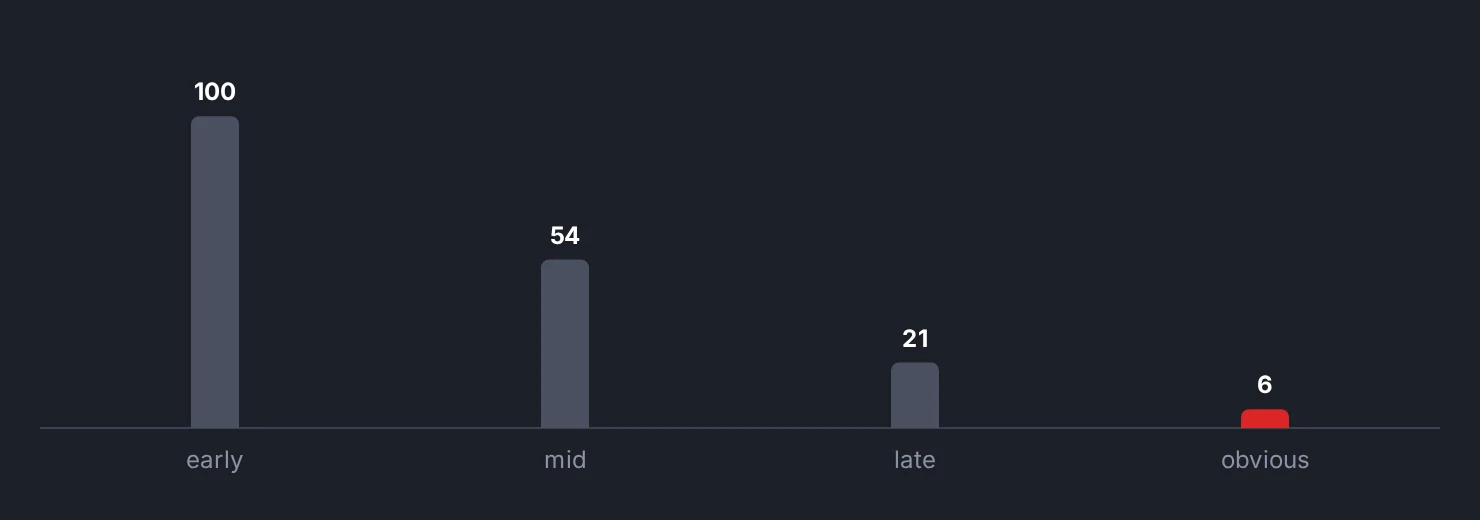
The reward side shrinks at the same time
FOMO is doubly unkind because the two halves of your risk-reward move against you together.
If a move typically runs 20% before it consolidates, and you entered after 12 of them, the remaining 8% is what you are actually trading for. Your risk went up and your available reward went down in the same click. A setup that was 3R before the move is often well under 1R after it.
You can check this arithmetic in ten seconds, and doing so is most of the cure. Before entering, write the entry, the invalidation level, and the nearest place you would realistically take profit. If the resulting ratio is below whatever minimum you trade, the decision is made for you and it has nothing to do with how strong the move looks.
Why it feels different in the moment
The urgency is not irrational, it is just misdirected. A fast move genuinely does carry information, and sometimes it is the start of something. Your brain is responding to a real signal.
But the signal you are reacting to is visible to everyone at once. By the time a candle is large enough to pull your attention across the room, the participants who caused it are already positioned, and the ones who will provide your exit liquidity are people in exactly your state.
There is also a scarcity illusion. It feels like this is the last opportunity, when the honest count is that markets produce setups continuously and the specific one you missed is not structurally different from the one that will appear next week. Missing a trade costs zero. Taking a bad version of it costs real money.
The mechanical fix: a pre-commitment, not a judgment call
Judgment is exactly what fails here, so remove it from the loop.
Define your entry condition before the move, in writing. A price level, a retest, a close above a specific value, a specific bar structure. If the market did not produce the condition, there is no trade, whatever the move did afterward.
Add a "no market orders on a vertical candle" rule if you need a blunt one. Requiring a limit order at a defined level makes chasing physically awkward, which is most of what a rule needs to do.
Cap risk by stop distance, not by conviction. If your stop is four times wider than usual, your position must be roughly a quarter of the size. Indikora derives size that way by default: risk per trade is fixed at 0.5% to 0.75% of equity by style, and the position is whatever that risk allows given the distance to a chandelier stop set at the highest price since entry minus 3 x ATR. A wider stop mechanically produces a smaller position, which removes the negotiation.
Indikora's Coach also flags this pattern after the fact. It classifies each decision as rational, FOMO, revenge, fatigue, overconfidence or overtrading, so the count of your chased entries is a number rather than an impression.
What "missing it" is worth
There is a useful reframe that is not a platitude. Track, for a month, every trade you did not take because it had already run. Record what would have happened. Most traders find that the skipped set is roughly break-even to slightly negative after costs, which means the discipline cost them nothing and saved them the tail losses.
The move you missed is not the opportunity. The setup you defined in advance is the opportunity, and it either appears or it does not.
Entering late does not just get you a worse price, it forces a wider stop or a tighter one, and both versions quietly wreck the risk-reward you thought you were taking.
Check yourself
Step a strong trending day forward one bar at a time and, at the point you would normally have clicked in, write down the entry, the invalidation level, and the resulting risk-reward before revealing the next bars.
Bar replayIndikora has a free simulator, bar replay and a behavioral coach that reads your own trades.
Open the app