
Process versus outcome: grading decisions, not luck
You broke your rules, doubled the size, and it worked. You made more on that one trade than on the previous six combined.
Your brain has now recorded that as a success, and it will suggest it again. That is the expensive part. Not the trade, which was profitable, but the entry it just made in your internal model of what works.
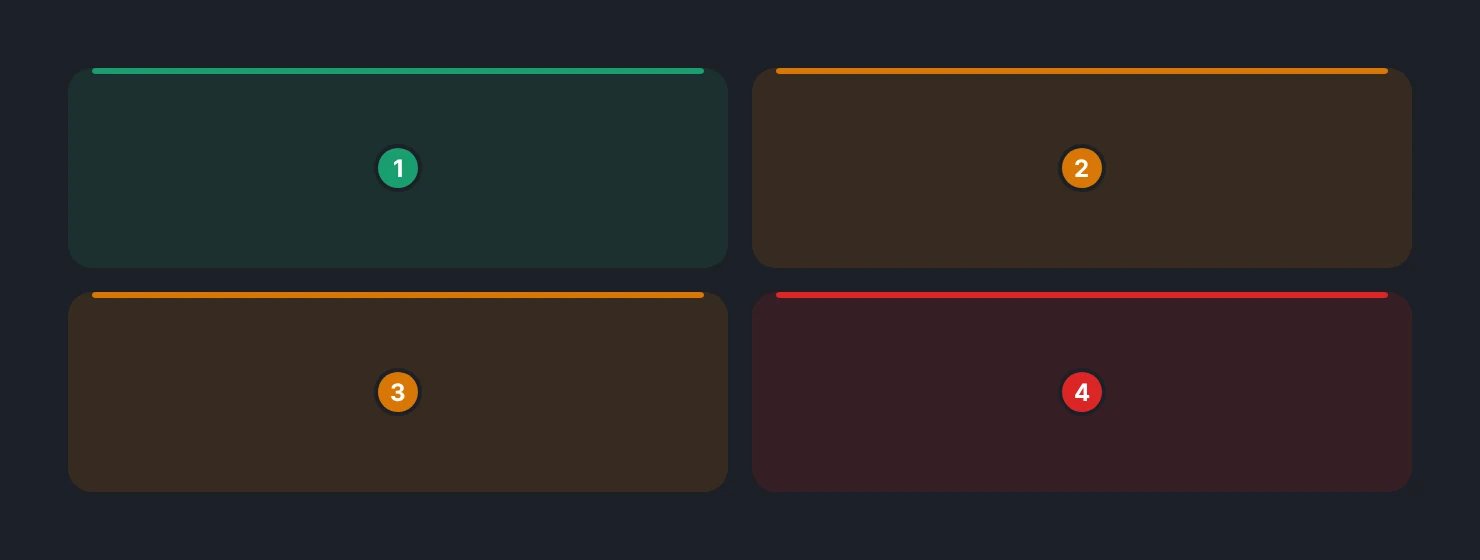
Four boxes, not two
Every trade lands in one of four cells: good decision that won, good decision that lost, bad decision that won, bad decision that lost.
Only the diagonal teaches you anything reliable. The other two cells are where the damage lives, and they are the ones your emotions handle worst.
Good decision, lost. This one feels like failure and produces rule changes. A system with a 45% win rate produces a lot of these, and every one of them is an invitation to fix something that is not broken.
Bad decision, won. This one feels like validation and produces repetition. It is worse than a loss, because a loss at least prompts a review. Nobody reviews the trade that made money.
Over a hundred trades, a feedback loop that only reads the outcome column will systematically reinforce the rule breaks that happened to pay and systematically punish the disciplined trades that happened not to.
Why the outcome tells you so little
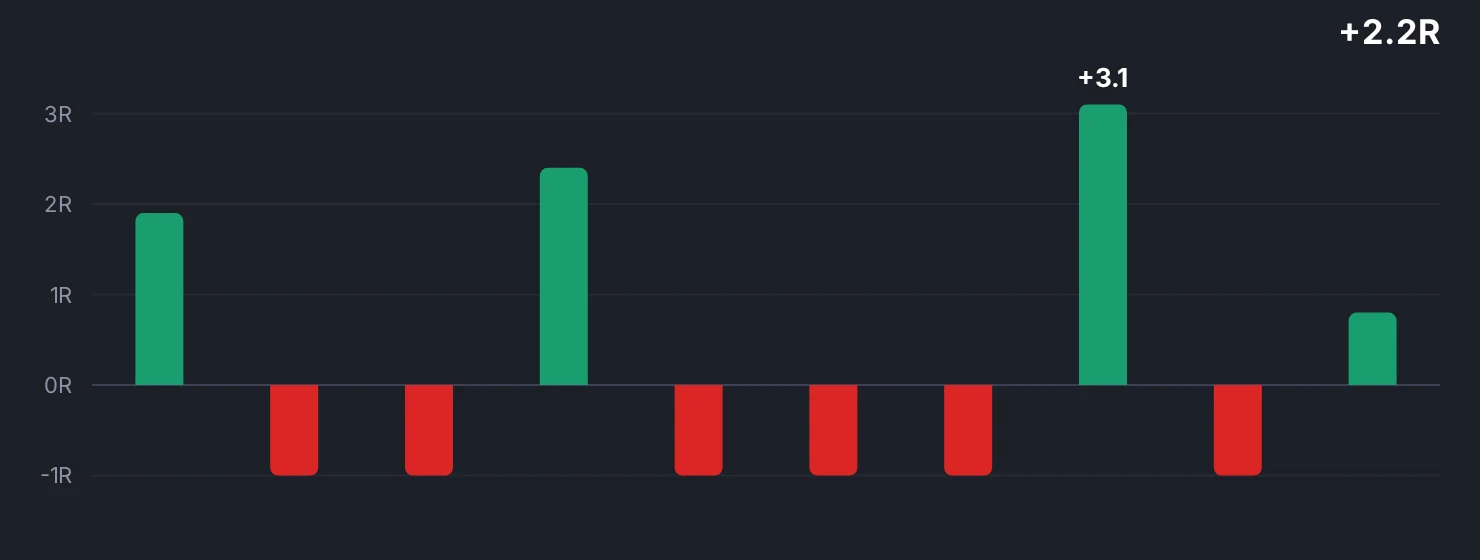
The signal-to-noise ratio of a single trade result is close to zero, and that is not a figure of speech.
If your edge gives you a 55% win rate, then the outcome of any given trade is 45% likely to point the wrong way about the quality of the decision. To distinguish a 55% system from a 50% system with reasonable confidence, you need hundreds of trades, not dozens.
So any conclusion you draw from ten trades is almost certainly about the market's noise, not your process. People rebuild strategies after five losses. Five losses at a 55% win rate happen roughly once every fifty trades by chance alone.
The practical consequence: the sample size at which results become informative is far larger than the sample size at which they become emotionally unbearable. That gap is where most strategy abandonment happens.
Grading the decision instead
The decision, unlike the outcome, is fully observable at the moment you make it, and it can be scored before the market has an opinion.
Score each trade on the things that were knowable at entry. Something like:
Did the setup meet every written condition? Not most of them. Every one. Binary.
Was risk sized by the rule? Compare the actual risk taken against your standard. Any deviation is a process failure regardless of result.
Was the invalidation written before entry? Yes or no.
Was the exit taken by the rule or by feel? This is where most process failures show up, and it is independent of whether the exit was profitable.
Was the timing clean? Not inside a cooling-off window, not after a session cutoff, not chased.
Five binary checks give a score from 0 to 5. Write the score at entry, before the outcome exists, and timestamp it. Then, over time, plot average R against the entry score. If your 5-out-of-5 trades outperform your 2-out-of-5 trades, your rules are doing something. If they do not, your rules need work, and that is a real finding rather than a reaction to a losing week.
This is the review that changes behavior, because it separates "I lost money" from "I made a bad decision", and only the second one is actionable.
What calibration looks like when it is done properly
The same principle applies to any probabilistic claim, including the ones a system makes about itself. A forecast of 60% is not wrong when the event does not happen. It is wrong if, across everything it called 60%, the event happened 30% of the time.
Indikora publishes probability calibration for exactly this reason: when it says 60%, you can check how often it was right across the whole set. And every published signal is SHA-256 hashed and chained to the previous one, so the record cannot be edited or back-dated. That is the institutional version of timestamping your decision score before the outcome arrives.
Two habits worth keeping
Review winners with the same scrutiny as losers. Set a standing rule that any trade scoring below 4 gets written up whether it made money or not. Otherwise your winners never get examined and your worst habits stay profitable-looking.
Judge the period, not the trade. Look at process scores weekly and results quarterly. Results at a weekly frequency are noise you will act on. Process scores at a weekly frequency are signal you can act on, because they are not random.
You do not control whether a trade wins. You control whether it was worth taking. Grade the part you control, let the other part accumulate, and stop letting a lucky rule break teach you how to trade.
In a market with heavy randomness, the result of a single trade is a poor signal about the decision that produced it, so grade the decision on its own scale and let results accumulate.
Check yourself
Score your next 20 trades from 0 to 5 on written criteria at the moment of entry, then plot average R by score to see whether your high-scoring decisions actually outperform.
Trade journalIndikora has a free simulator, bar replay and a behavioral coach that reads your own trades.
Open the app