
Order types: market, limit and stop
Every order you will ever place is a choice between two guarantees, and you can only have one. Either you are certain the trade happens and uncertain what it costs, or you are certain what it costs and uncertain whether it happens.
That single tradeoff explains market orders, limit orders, stop orders, and every hybrid built on top of them. Once you see it, the menu on your broker's ticket stops being intimidating and starts being a set of answers to the same question.
Market orders: certainty of execution
A market order says "fill me now at whatever the book has". It walks up the resting orders on the other side until your quantity is complete.
In a liquid market this is boring and fine. If a hundred million dollars sits within a tick of the current price, your order fills at essentially the number you saw. The cost is the spread, which is small and predictable.
In a thin market or during a news release, the same order can walk a long way. The book empties out, your fill price is an average of everything it consumed, and the difference between the price you expected and the price you got is slippage. The lesson "Spread, slippage and fees: the invisible tax" gets into how much that actually costs over a year.
Market orders are also the order type that behaves worst in exactly the situations where you feel most urgent. The moment you most want out is usually the moment the book is thinnest, because everyone else feels the same way. That is not a reason to never use them. It is a reason to know what you are paying.
Limit orders: certainty of price
A limit order says "fill me at this price or better, and otherwise do not fill me". You post it, it sits in the order book, and it waits.
The guarantee is real and so is the cost. If price never comes to your number, you do not get the trade. If price touches your number and reverses immediately, you might still not get filled, because everyone who posted before you at the same price is in front of you in the queue.
Limit orders also have a hidden asymmetry that catches beginners. A limit buy that fills is a limit buy that someone was willing to sell into. Your best fills, statistically, happen when the market is moving through you, which is not always the moment you would have chosen.
Most exchanges charge lower fees for limit orders that rest in the book, because you are supplying liquidity rather than taking it. Some platforms offer a "post only" flag that cancels the order rather than letting it execute as a taker, which protects that fee tier.
Stop orders: a trigger, not a price
This is where most of the confusion lives. A stop is not an order type, it is a condition attached to one.
A stop order sits inactive until price reaches your trigger level. At that point it converts into either a market order or a limit order, depending on which variant you chose, and the difference matters enormously.
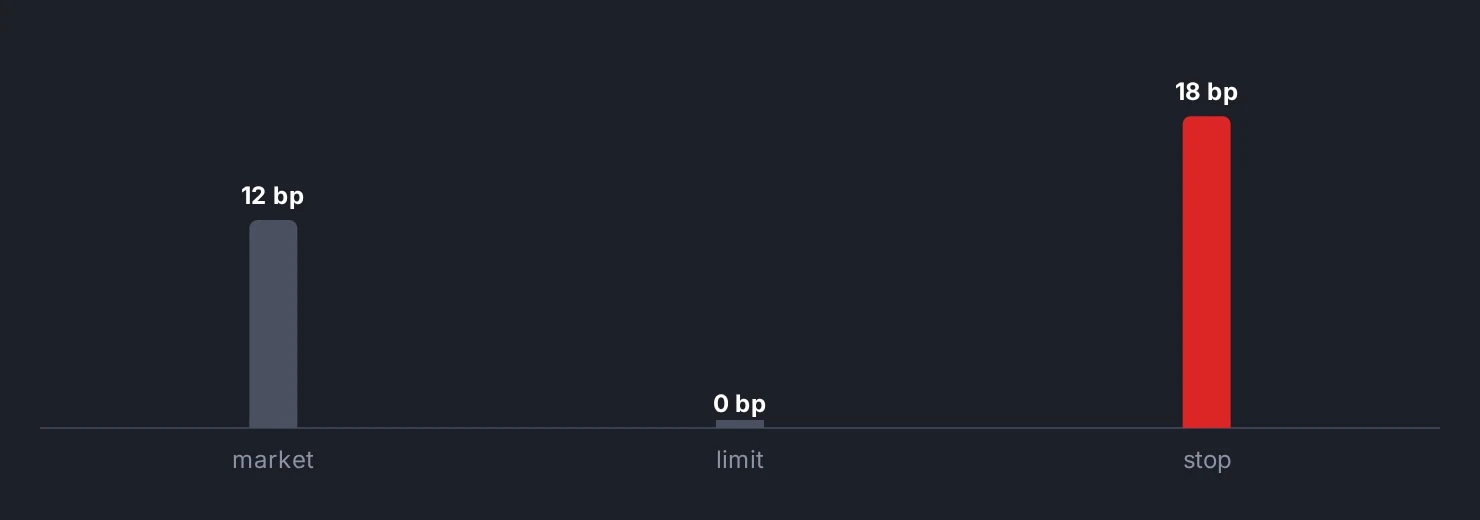
A stop-market guarantees you get out and does not guarantee the price. If price gaps straight through your trigger, your stop becomes a market order in a fast-moving book and fills wherever it can. That fill can be well beyond your intended level.
A stop-limit guarantees the price and does not guarantee you get out. If price gaps past your limit, the order becomes a resting limit order that never fills, and you are still holding the position while it moves further against you. Traders who chose stop-limit to avoid slippage sometimes discover this during the one event it was supposed to protect them from.
There is no correct answer between the two. There is a decision about which failure you can live with, and it should be made before you need it rather than during.
Everything else is a combination
Trailing stops move the trigger as price advances in your favor and leave it alone when price moves against you. Indikora's chandelier exit is this idea expressed as a rule: the highest price since entry minus three times the average true range, so a volatile asset gets a wider stop and therefore a smaller position for the same risk.
OCO, or "one cancels the other", pairs a profit-taking limit with a protective stop so that filling one removes the other. Bracket orders wrap an entry and both exits into a single ticket. Reduce-only flags on derivatives venues prevent an order from accidentally opening a position in the opposite direction.
None of these are new mechanisms. They are the same three primitives with conditions bolted on.
The order type is part of the trade, not an afterthought at the end of it. A well-reasoned idea executed with the wrong order type becomes a different trade with different risk. Decide the entry, the exit trigger, and what happens if price gaps, and you have removed a category of surprise that has nothing to do with whether you read the chart correctly.
A market order guarantees execution but not price, a limit order guarantees price but not execution, and you never get both.
Check yourself
Open the same position twice in the simulator, once with a market order and once with a limit order at the current bid, and record the fill price difference and whether the limit filled at all.
SimulatorIndikora has a free simulator, bar replay and a behavioral coach that reads your own trades.
Open the app