
Leverage and margin: what actually liquidates you
The standard warning is that leverage is dangerous because it multiplies your losses. That is true and it is also the least useful way to say it, because it leaves out the part that actually empties accounts.
Leverage does not change how much you lose when a trade goes wrong. Your position size does. What leverage changes is how far price is allowed to move before the exchange takes the decision out of your hands.
Margin is a deposit, not a purchase
When you open a leveraged position, you are not buying the asset. You are posting collateral against an obligation. Ten thousand dollars of exposure at 10x leverage means you have put up one thousand dollars of margin and the venue is carrying the rest.
That thousand dollars is the entire buffer between you and forced closure. If the position loses a thousand dollars, there is nothing left backing it, and the venue closes it to protect itself. In practice it closes earlier, at the maintenance margin level, which is a threshold set so that the liquidation engine has room to work before your collateral is actually gone.
Two structures exist and the difference is worth knowing before you need it. Isolated margin ring-fences the collateral for one position: the worst case is that position's margin. Cross margin lets your whole account balance back every open position, so a single trade can consume everything, and a losing trade can be kept alive by the equity of an unrelated winning one until neither survives.
The arithmetic of the liquidation price
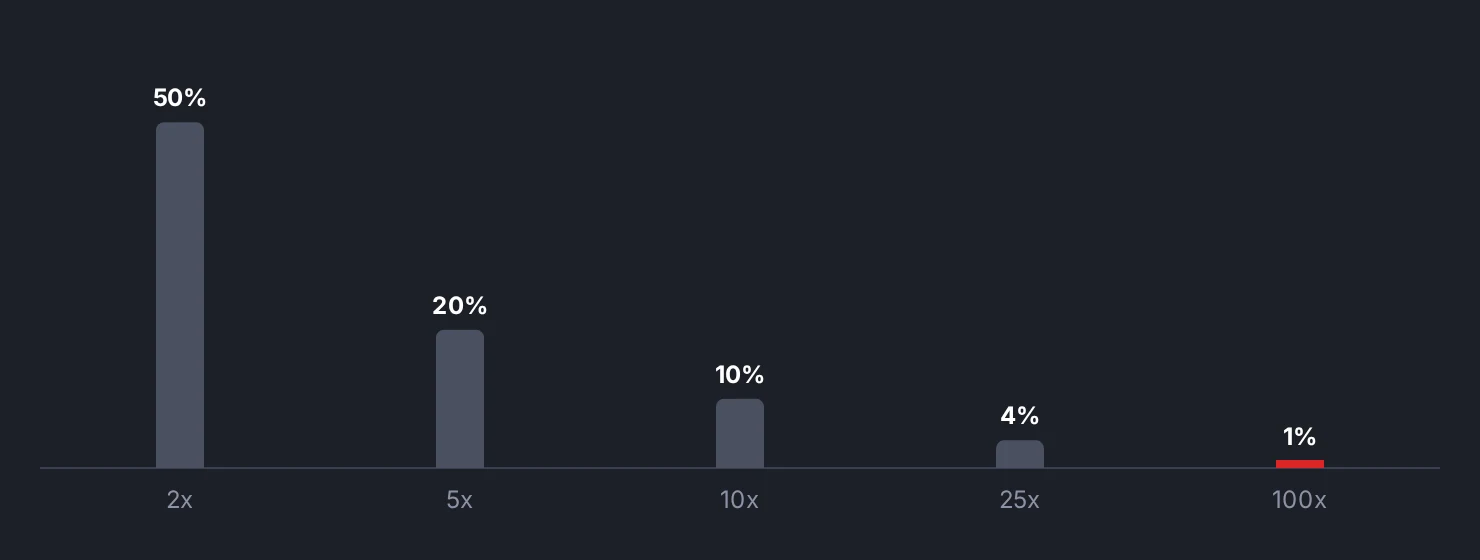
The rough version is simple enough to do in your head. At X times leverage, a move of roughly 100 divided by X percent against you wipes out the margin.
At 5x, that is about 20%. At 10x, about 10%. At 50x, about 2%. At 100x, about 1%, which on most crypto pairs is a normal Tuesday afternoon.
Fees, funding and the maintenance requirement all pull the real trigger closer than the headline number, so the actual liquidation price is always a little nearer than the arithmetic suggests. Every venue publishes a formula, and it is worth reading once for the venue you actually use.
The reason high leverage kills accounts is not that losses are bigger, it is that the exit is no longer yours. A trade that would have recovered gets closed at the worst tick of the move, and the recovery happens without you. You were not wrong about direction. You were wrong about how much noise you could survive.
Leverage and position size are different decisions
This is the part that reframes everything, and most beginners never have it explained.
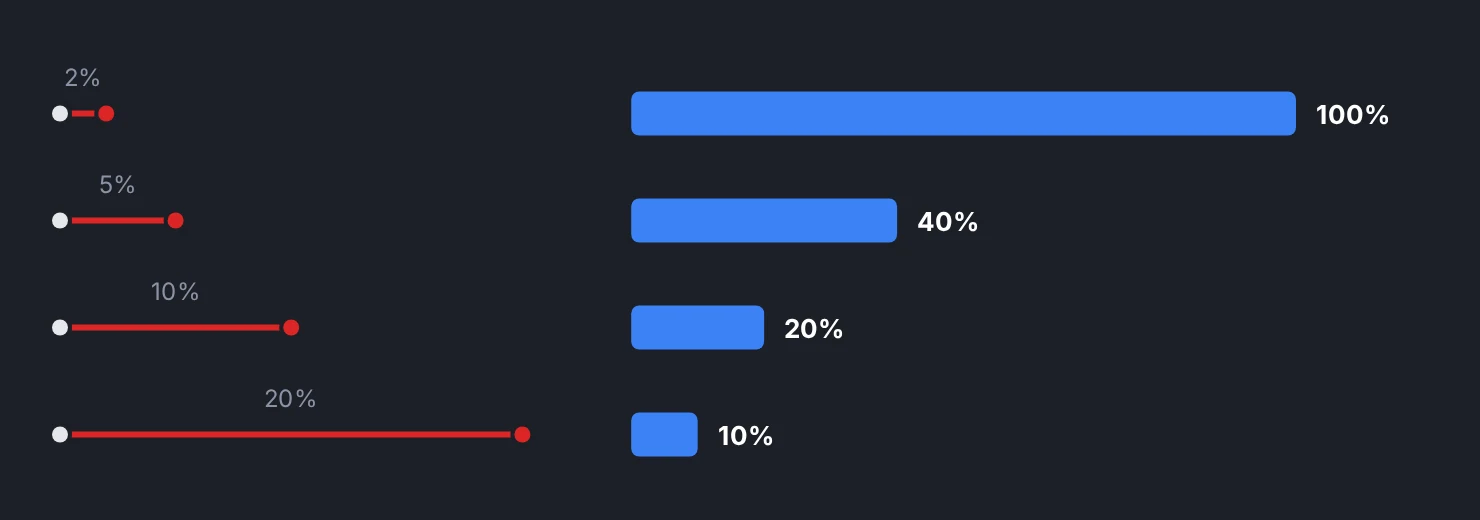
Suppose you have 10,000 dollars and you risk 1% on a trade, which is 100 dollars. You place your stop 5% below entry. That means your position is 2,000 dollars, because 5% of 2,000 is 100.
If your account is unleveraged and you only have 10,000, you need no leverage at all for that. If your stop is 1% away instead, the same 100 dollars of risk requires a 10,000 dollar position, which fits exactly. Tighter stop, bigger position, identical loss if you are wrong.
Leverage only enters the picture when the position your risk math produces is larger than your account. It is a plumbing tool that lets you hold the size your stop distance requires. It is not a dial for how aggressive you are.
Once you see it that way, "I trade at 20x" stops being a meaningful statement. Twenty times leverage with a stop 0.5% away risks less than 2x leverage with a stop 30% away. The leverage number alone tells you nothing about risk.
How systematic approaches handle it
The consistent pattern in rule-based systems is that risk is fixed first and everything else is derived. Indikora defaults to risking 0.5% to 0.75% of equity per trade depending on style, then derives position size from the distance to the stop, which is the highest price since entry minus three times the average true range.
The consequence is automatic and slightly counterintuitive: a volatile asset gets a wider stop, and a wider stop means a smaller position for the same dollar risk. The volatility does not increase your exposure, it shrinks your size. That is the opposite of what happens when someone picks a leverage multiple first and works backward.
A margin call is information arriving too late. By the time a venue asks for more collateral, the decision about how much you could lose was made when you opened the position, at a moment when you were calm and had every option available.
That is the whole argument for deciding size from stop distance rather than from how confident you feel. Confidence is not measurable and does not survive a fast candle. Stop distance is a number you can write down before anything happens.
Leverage sets how far price can move before you are forced out, but the size of your position is what decides how much you lose.
Check yourself
Fix your risk at 0.5% of a hypothetical account, then use the position-size calculator to compute the size for stops at 1%, 5% and 20% away, and note how much leverage each one would require.
Position calculatorIndikora has a free simulator, bar replay and a behavioral coach that reads your own trades.
Open the app