
Going short: how a falling price pays
The first time someone explains shorting, it sounds like a trick question. You sell something you do not own, at a price you like, and buy it back later for less. Where did the thing you sold come from?
You borrowed it. That is the whole answer, and every strange property of a short position follows from the fact that you are holding someone else's asset and owe it back.
The mechanics, in order
You borrow the asset from someone who owns it, through your broker. You sell it immediately at the current market price and the cash lands in your account. Later you buy the same quantity back and return it to the lender. Whatever is left of the cash is your profit or your loss.
Sell 10 shares at 100, buy them back at 80, return the shares. You collected 1,000 and spent 800, so you keep 200 before costs. If instead you buy them back at 130, you spent 1,300 to return what you sold for 1,000, and you are down 300.
The position is an obligation, not an asset. You do not own anything while it is open. You owe something, and the amount you owe is repriced continuously by the market.
In crypto and forex the borrowing is usually invisible because you are trading a derivative rather than the thing itself. A perpetual futures contract lets you take a short position with no explicit borrow at all. The obligation is still there, it is just expressed as a contract with the exchange rather than shares from a lender.
Why the risk is not the mirror image of a long
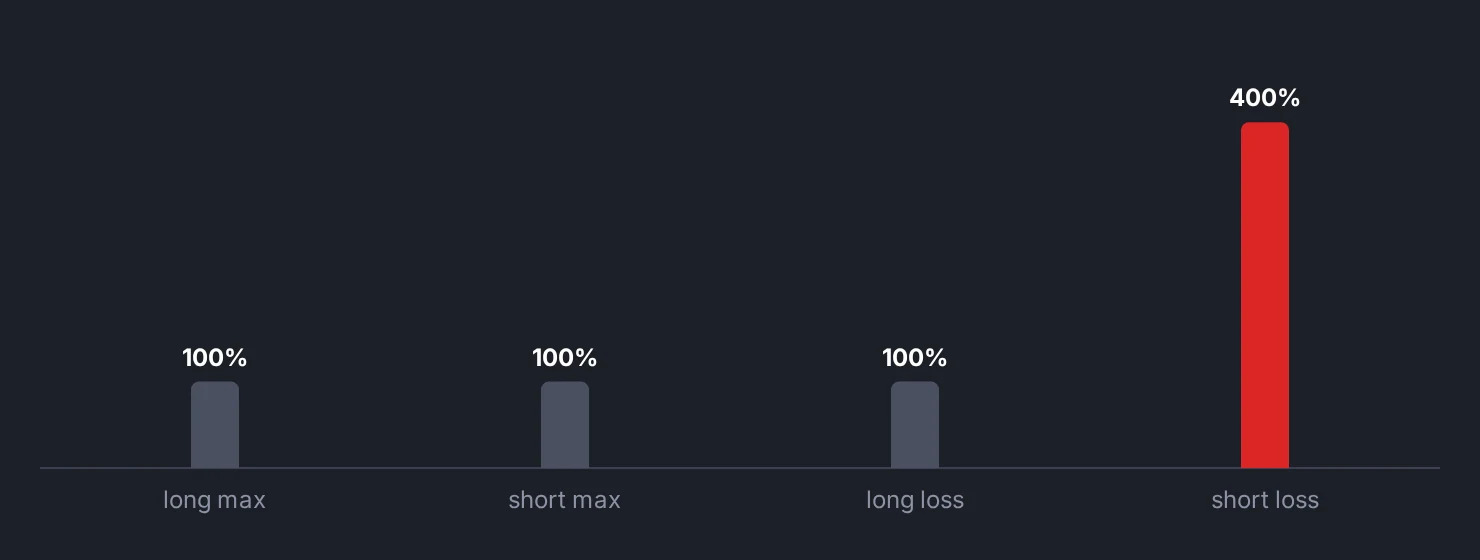
Buy something at 100 and the worst case is that it goes to zero. You lose 100. Your downside is bounded by arithmetic, and it is known the moment you enter.
Short something at 100 and there is no equivalent ceiling. Price can go to 200, 500, 1,000. The loss is not capped by anything except how far buyers are willing to push, which is not a number anyone can write down in advance.
In practice you will be liquidated long before "unlimited" becomes literal, because your margin runs out first. But that is not comfort. It means the failure mode of a short is being forced out during a fast move, which is exactly when a fast move is happening.
There is a second asymmetry that gets less attention. As a long position moves against you, it becomes a smaller share of your account, so its influence shrinks. As a short position moves against you, it grows, so a losing short takes up more and more of your risk budget without you doing anything. The position gets heavier precisely as it gets worse.
The costs of holding one
A short position bleeds while it waits, and a long one usually does not.
Borrowing a stock costs a fee, quoted annualized, and the fee is set by supply. A widely held, easily borrowed stock costs a fraction of a percent. A crowded short with little available float can cost tens of percent per year, and the rate can change while you hold. If the lender recalls the shares, you can be bought in involuntarily.
Short a dividend-paying stock and you owe the dividend to the lender, since they would have received it. On crypto perpetuals, the funding rate flows between longs and shorts depending on which side is crowded, and when everyone is short you are the one receiving it, which is one of the few times the cost runs in your favor.
None of these appear on the chart. They appear on your statement.
Short squeezes and why crowding matters
Every short is a future buyer, and that is not true of a long. To close, you must buy. If a lot of shorts are forced to close at once, they are all buying into the same move, which pushes price further up, which forces more of them to close.
That feedback loop is a short squeeze. It does not require a conspiracy or a coordinated campaign, though those exist. Crowding plus a catalyst is enough.
This is why short interest and funding rates get watched: they are measurements of how many people are already on one side. A market where the funding rate is deeply negative is telling you that shorts are paying to stay short, which is a description of positioning, not a forecast.
Where it fits in a rule-based approach
Some systematic frameworks trade both directions, and some deliberately do not. Indikora's trend conditions are long-only by construction: it looks for assets above their 50-day average with positive 28-day momentum, so an asset that fails those tests is simply not eligible rather than becoming a short candidate. That is a design choice about which behavior is being measured, not a claim about which direction is better.
The honest summary of shorting is that it is a legitimate mechanism with a genuinely different risk shape. Bounded gains, unbounded losses, an ongoing carrying cost, and a crowd that can turn into a stampede of buyers. Knowing that before you use it is the difference between a tool and a surprise.
A short position profits when price falls, but it costs money to hold and its losses have no natural ceiling.
Check yourself
Open a short and a long of equal size on the same asset in the simulator, hold both for a week, and compare the carrying costs shown on each side.
SimulatorIndikora has a free simulator, bar replay and a behavioral coach that reads your own trades.
Open the app