
Liquidity and sessions: when a market is really open
Crypto never closes. Forex trades 24 hours, five days a week. Both statements are true and both are misleading, because being open is not the same as being able to trade.
Liquidity is the property that actually matters, and it has a schedule. The same order that costs you nothing at 3pm London can cost you half a percent at 3am, on the same asset, on the same venue, with nothing else changed.
Liquidity is depth, not volume
Volume tells you how much traded. Liquidity tells you how much could trade without moving the price. They correlate, but they are not the same, and the difference shows up in your fills.
Picture the order book as a staircase of resting orders at successive prices. A deep book has thick steps: large quantities sitting close together, so a big market order eats through several of them and barely moves. A thin book has a few small orders spread far apart, so the same order walks a long way and your average fill is nowhere near the price you saw.
Three things describe it. The spread, which is the distance between the best bid and best ask. The depth, which is how much size sits within a given distance of the mid price. And resilience, which is how quickly the book refills after someone takes it out.
The dangerous combination is a book that looks fine and is not resilient. It quotes tight, absorbs your first order, and then does not refill for several seconds, which is exactly what happens around scheduled news.
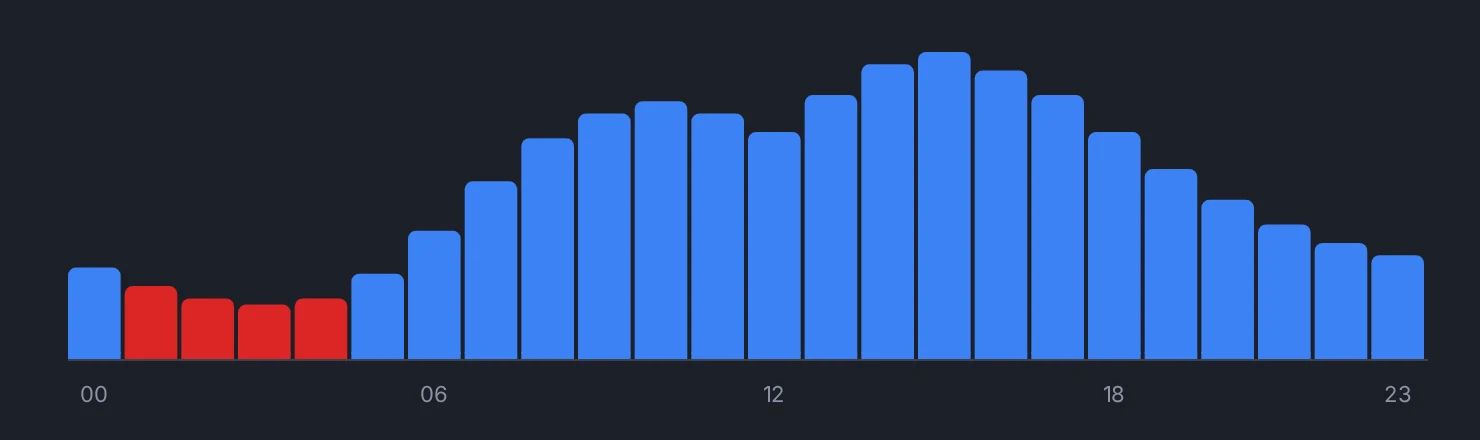
The session clock
Institutional flow follows working hours, and it does so with remarkable regularity.
Tokyo, London and New York are the three anchors. London opens while Tokyo is finishing, and New York opens while London still has several hours left. That London and New York overlap, roughly 1pm to 4pm UTC depending on daylight saving, is the deepest window in currencies, and it is when the majority of daily range in EUR/USD and GBP/USD typically forms.
Outside that window liquidity thins in stages. The hours between the New York close and the Tokyo open are the quietest of the day, and spreads on secondary pairs can be several times their daytime level.
Equities are simpler and stricter. The exchange has an open and a close, and liquidity is heavily concentrated in the first and last half hour. Pre-market and after-hours sessions exist but with a fraction of the depth, which is why a stock that moves 6% after hours often gives most of it back once the real session begins and actual size arrives.
Gold and index futures trade nearly around the clock but inherit the same rhythm, because the participants keep the same office hours.
Crypto's version of the same problem
Crypto has no official close, which removes the gap risk that equity traders live with and replaces it with something subtler.
Weekend crypto is thin crypto. Institutional desks are largely absent from Friday evening to Monday morning, so the book is thinner and a given amount of buying or selling moves price further. Weekend moves are therefore not directly comparable in meaning to weekday moves of the same size, because the same price change required less capital to produce.
The same applies at the very small end of the market. A token with a few hundred thousand dollars of daily volume can look like it has a beautiful trend on the chart while being effectively untradeable at any size, because getting out would move the price against you more than the trend gained.
What thin liquidity actually does to you
It widens the spread, so every round trip costs more. That is the visible part.
It increases slippage on stops. A stop-market order in a thin book fills wherever it can, and "wherever it can" is much further away at 4am than at 2pm.
It makes wick hunting mechanical rather than conspiratorial. In a thin book, a modest sell order can reach down through a cluster of stops, trigger them, and snap back within a minute. People call this manipulation. Usually it is just arithmetic: nobody was there to absorb it.
And it distorts every indicator you use. An average true range computed across low-liquidity hours mixes two different market conditions into one number, which is one reason daily-timeframe measurements are more stable than intraday ones.
Using the clock without predicting anything
Session knowledge is about execution and expectation, not direction. The London-New York overlap tells you when a large order will cost less. A scheduled rate decision tells you when depth will disappear for a few seconds, regardless of what the number turns out to be. A Sunday move tells you how much weight to give it.
Indikora's daily-timeframe design intersects with this in one practical way: because trend and the chandelier stop are both evaluated on daily closes, the measurements are taken from full sessions rather than from a specific liquidity window, which removes the question of which hour of the day the reading came from.
The one-sentence version is worth keeping. A market is open when the venue says so and liquid when there is someone on the other side, and only one of those two facts is on the exchange's website.
Liquidity is how much size a market can absorb without moving, and it follows the clock more reliably than price does.
Check yourself
Replay one full week of a single asset on the 1-hour chart and mark, for each day, the three-hour window with the widest bars, then compare those windows to the London and New York session times.
Bar replayIndikora has a free simulator, bar replay and a behavioral coach that reads your own trades.
Open the app