
Fatigue: the trades you take at 2am
Look at the timestamps on your five worst trades. There is a reasonable chance at least two of them were placed after midnight, or at the end of an eight-hour session where you had already been staring at the same chart for four hours.
Crypto never closes, and that is the whole problem. Equity markets impose a cutoff on you. A 24-hour market makes staying up an option, and the option gets taken most often on the nights you should least be taking it.
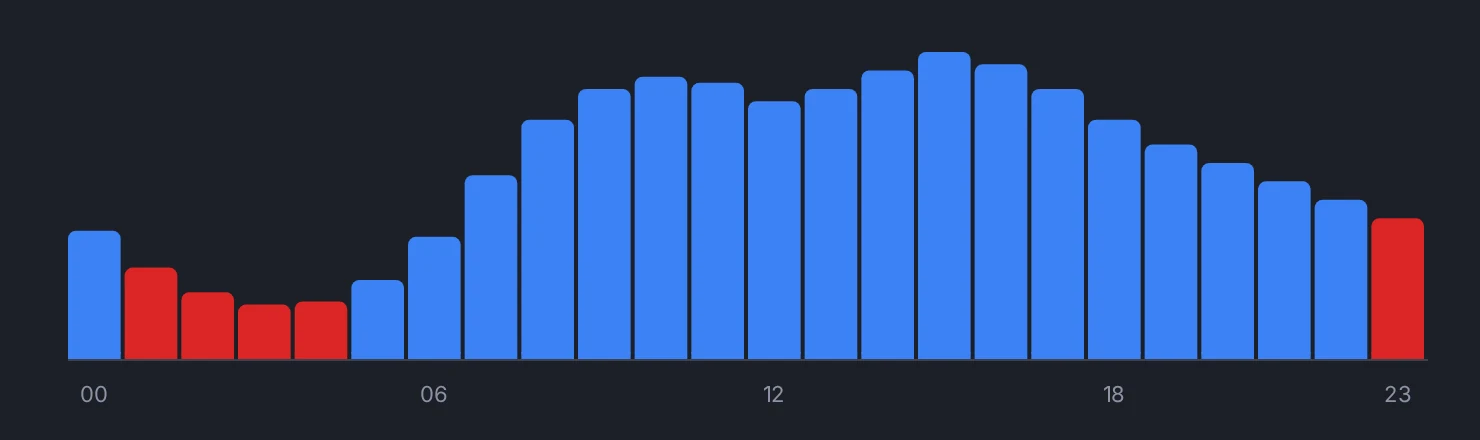
What tiredness actually changes
Fatigue is not a general dimming. It hits some functions much harder than others, and the ones it hits hardest are the ones trading depends on.
Pattern recognition survives. Inhibition does not. You can still see the setup. What degrades is the part that says "yes, but the volume is wrong" or "yes, but I already have three positions in correlated assets". You keep the ability to generate ideas and lose the ability to reject them.
Risk sensitivity flattens. Tired decision-makers weight potential gains more heavily and potential losses less heavily than the same people do when rested. That shows up as bigger size and wider stops, and it does not feel like recklessness at the time. It feels like clarity.
And critically, you cannot self-assess. This is the part that makes fatigue different from tilt. After a loss you at least know you are annoyed. At 2am you feel fine. The instrument you would use to check whether you are impaired is the instrument that is impaired.
The compounding version
Fatigue rarely arrives alone. The reason you are still at the screen at 2am is usually that something happened: a position went against you, a move started without you, or you are waiting for a level that has not printed.
So the late trade is often a tired trade and a revenge trade and a FOMO trade at once. Each of those alone shortens your holding period and inflates your size. Together they produce the outlier loss that shows up on your equity curve as a step down rather than a slope.
Screen time itself is a cost. Four uninterrupted hours of watching a chart does not produce better decisions than one hour of checking it four times. It produces more decisions, and in a market where most bars are noise, more decisions is a worse outcome by default.
The countermeasure is a clock, not a feeling
Because you cannot self-assess in the state, the rule cannot depend on self-assessment. It has to be set in advance, in units that do not require judgment.
A hard end-of-session time. Pick an hour after which you place no new orders. Existing positions can keep their stops and targets, which is the point of having them set. If the setup appears at 01:30 and your cutoff is midnight, the setup does not exist for you.
A maximum screen block. Something like 90 minutes, then a break away from the screen. Set a timer that is not on the same device as the platform.
A pre-set alert instead of a vigil. If you are staying awake to watch a level, that is the job an alert does. Waiting at the screen for a level converts one decision into hundreds of chances to make a different one.
Move the exit off your attention. A stop and target that are already in the market do not require you to be awake or sharp. Indikora's exit rule works this way: a chandelier stop at the highest price since entry minus 3 x ATR, defined at entry and updated by the rule rather than by you at 2am.
Indikora's Coach labels each decision as rational, FOMO, revenge, fatigue, overconfidence or overtrading, and fatigue is flagged from the timing pattern around your fills. If most of your negative-R trades cluster in one two-hour window, that is a scheduling fix, not a strategy fix.
The trade you did not take
Traders resist the cutoff because it feels like leaving money on the table. Test it rather than arguing about it. For one month, log the setups you skipped because of the time rule, and mark what they would have done.
Most people find the skipped set is close to break-even, and the rule cost them nothing while removing the largest losses from the sample. That is a good trade in itself: you gave up the average and kept the tail.
Being tired is not a discipline failure and it does not need to be treated as one. It is a state with known effects on judgment, and the standard response to a state you cannot detect from inside is to decide in advance what you will do when it arrives.
Fatigue does not make you feel unable to trade, it makes you unable to notice that you should not, which is why the cutoff has to be a clock rather than a judgment.
Check yourself
Bucket your last 50 closed trades by the hour they were opened and find the two-hour window with the worst average R.
Trade journalIndikora has a free simulator, bar replay and a behavioral coach that reads your own trades.
Open the app